|
|
|
|
This is the Civilian Impact Monitoring Project's monthly visual and analytical report, providing an overview of all incidents of armed violence reported to have directly impacted civilians in Yemen in February 2026. The report covers civilian casualties, incident distribution, types of armed violence, and impacts on civilian property and infrastructure.
|
|
|
NATIONWIDE SNAPSHOT: CIVILIAN IMPACT FROM INCIDENTS OF ARMED VIOLENCE
|
|
|
|
|
|
|
Civilian Impact Incidents
Civilian Casualties* (Fatalities / Injuries)
Child Casualties (Fatalities / Injuries)
Women Casualties (Fatalities / Injuries)
|
|
|
|
|
|
57
110 (22 / 88)
17 (4 / 13)
7 (2 / 5)
|
|
|
|
|
|
|
Compared to previous month
|
|
|
|
|
|
Compared to 2025 monthly average
|
|
|
|
|
|
|
|
|
*Please note, all information and numbers included in CIMP reporting are based on information publicly available in open sources, and have not been independently verified
|
|
|
|
|
|
|
Civilian casualties decreased by a quarter in February compared to January
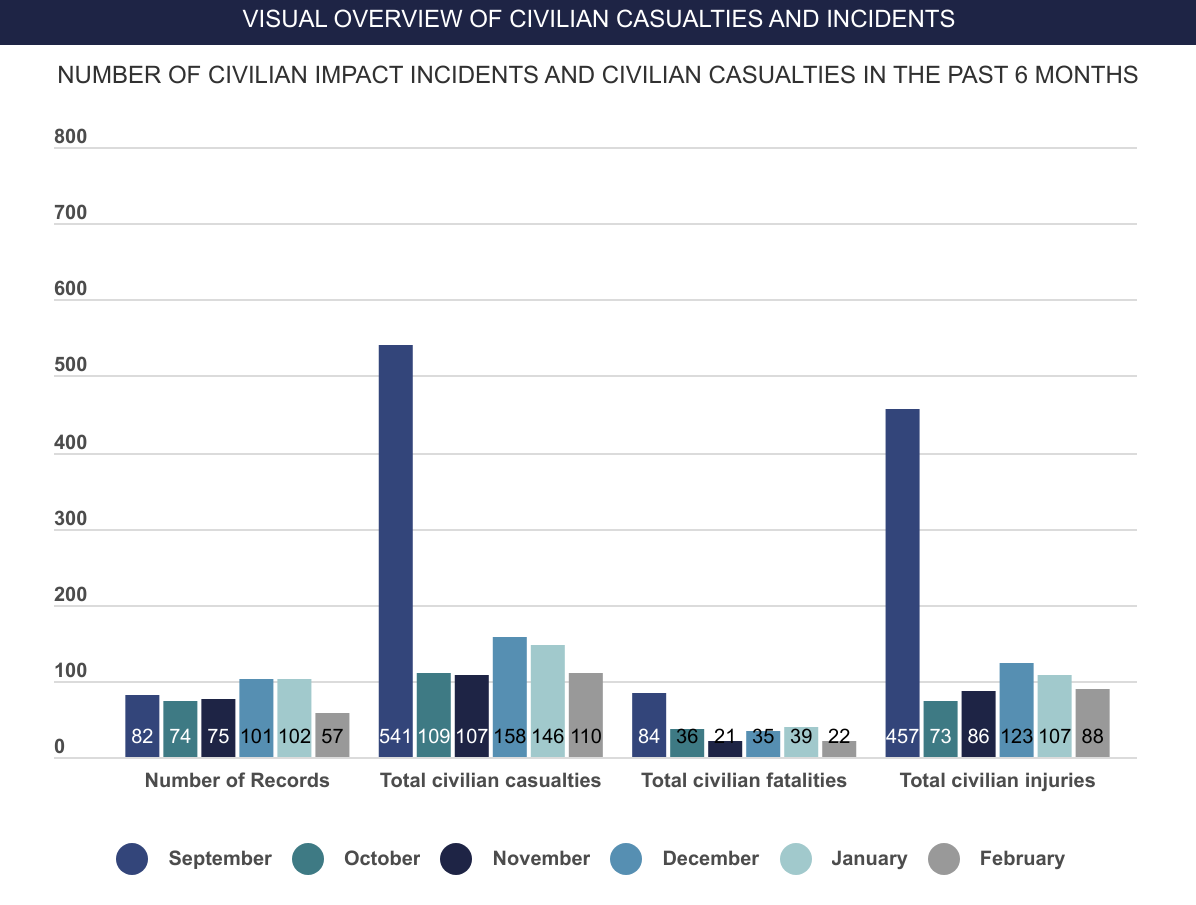
The civilian casualty toll from armed violence fell in February (110) by a quarter compared to January (147), dropping from the highs of the previous two months back to the level seen in October (109) and November (107). This decrease came in the wake of the military deployments and political tensions across the south of the country in December and January, which contributed to a spike in civilian casualty numbers. However, although casualties were down, child casualties (17) doubled compared to January (8), mainly due to a series of isolated shootings. Overall, children and women casualties (24) increased by a third compared to the previous month (16).
The coming month is likely to witness a similar level of deaths and injuries on the ground, but with conflict re-erupting across the region, there is a growing risk that casualties could surge if cross-border hostilities resume in Yemen. Military reinforcements have been mobilised to multiple fronts in the north of the country, and there have been reports of renewed military and civilian preparations in major cities in case of renewed drone and missile launches and retaliatory air strikes.
Frontline victims dropped to the lowest level in five months
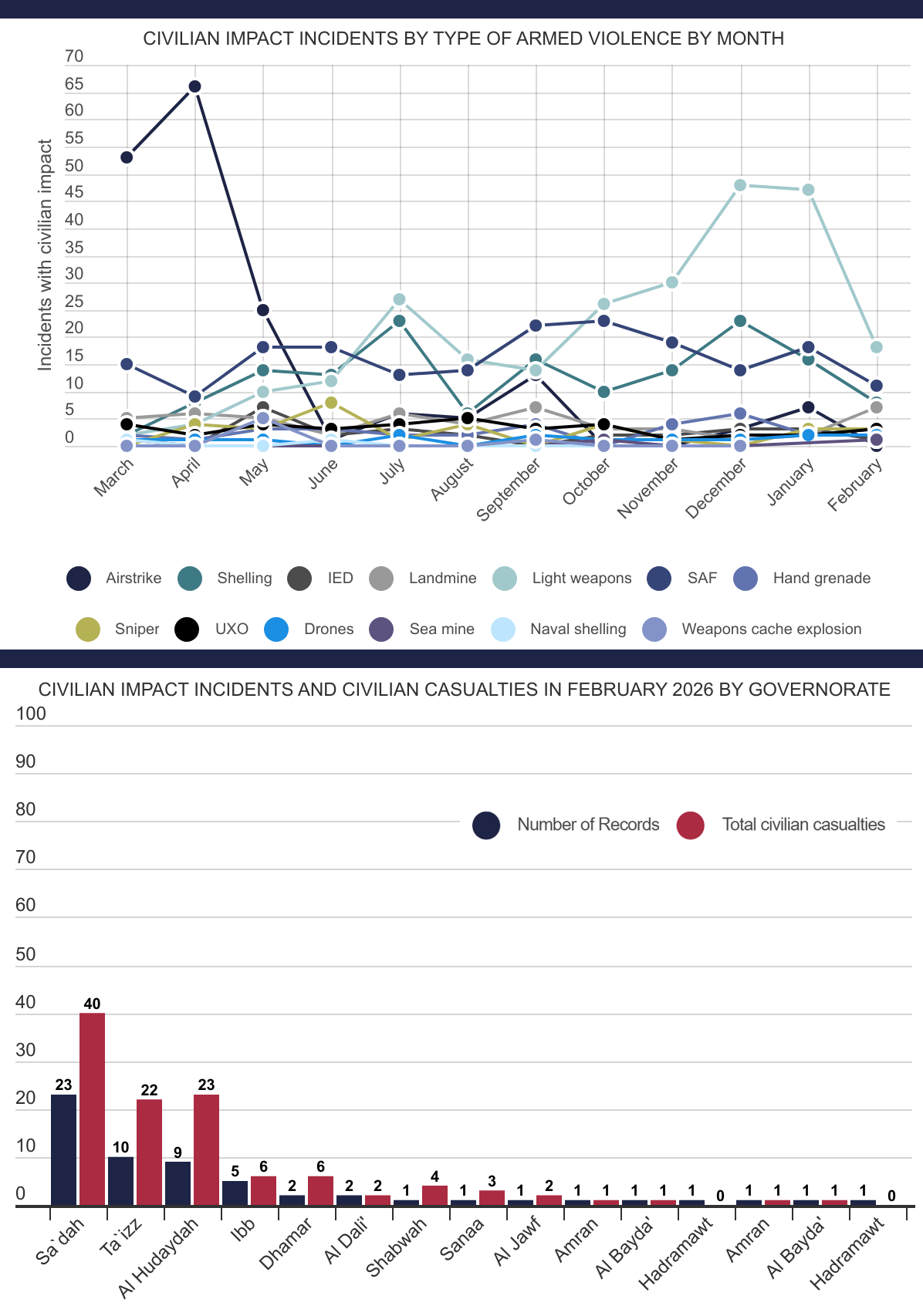
Civilian victims from frontline violence dropped by around a half in February (48) relative to January (89), the lowest since September (38). The drop in frontline casualties was primarily due to a 54% decrease in reported incidents in Sadah during February (39) compared to the previous month (85). Despite the sharp fall reported in Sadah, it is expected that the coming period will see casualty numbers pick up again, as has been the case during previous temporary dips in the northern governorate, which remains the most active front in the country.
Frontline activity in the rest of the country, meanwhile, saw brief spikes during the month, with Al Hudaydah, in particular, witnessing two notable escalations. Reports indicated that fighting erupted in the southeastern district of Hays on the border with Taizz in mid-February, resulting in dozens of military casualties, in an alleged attempt to take control of Hays city. The Al Hudaydah clashes are significant because they mark the first time any party has attempted to make territorial gains in recent years.
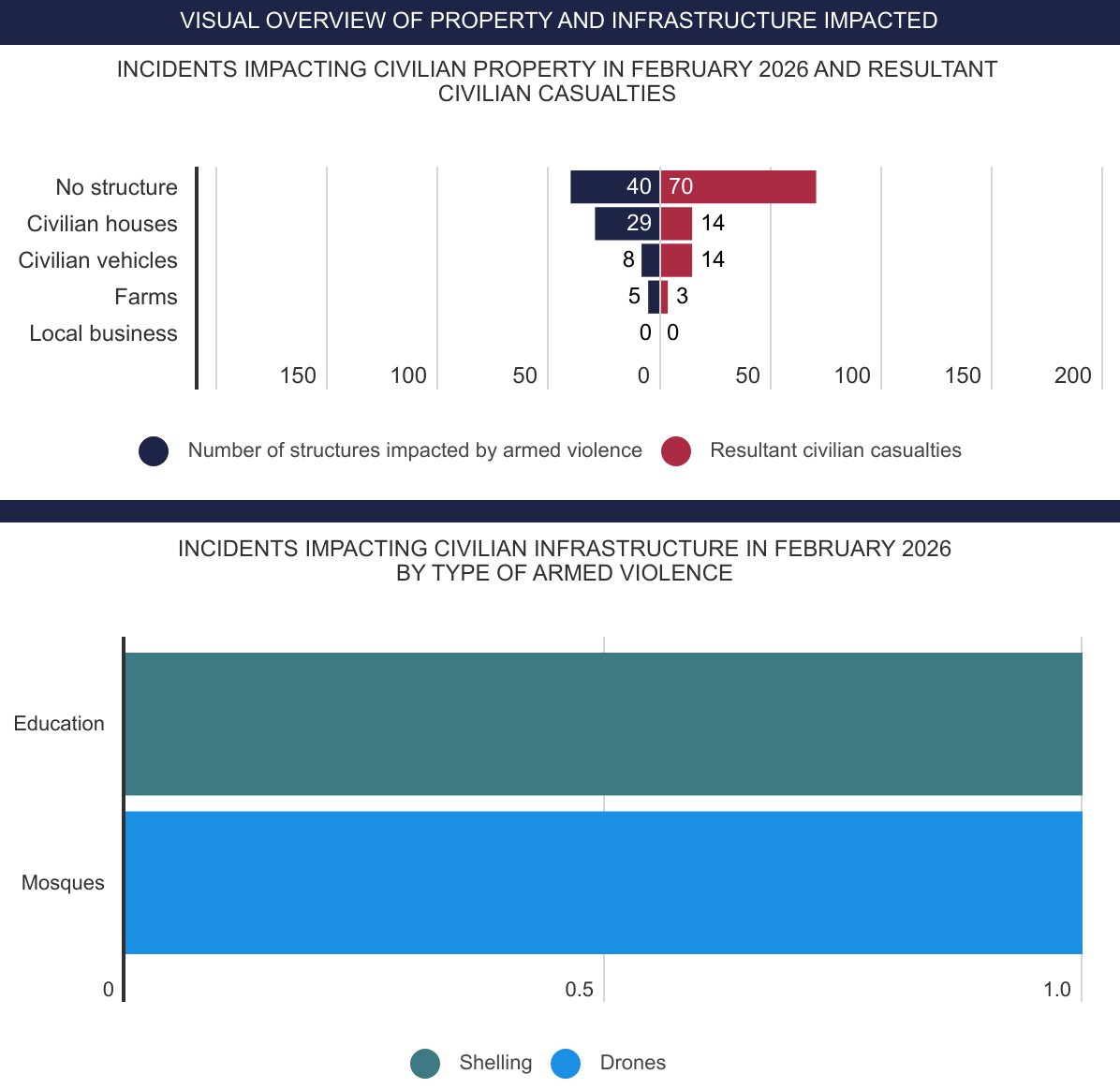
Meanwhile, in northern Ad Dali, Taizz city, and the border between Taizz and Lahij, military movements were also observed, but the tempo of the fighting remained similar to that of the past few months, with no territorial shifts or sustained fighting. Relatively low levels of violence will likely continue on the same fronts, along with occasional outbursts in southern and eastern Al Bayda, western Shabwah, southern Marib, and southern Al Hudaydah.
Isolated incidents caused a third of all civilian casualties
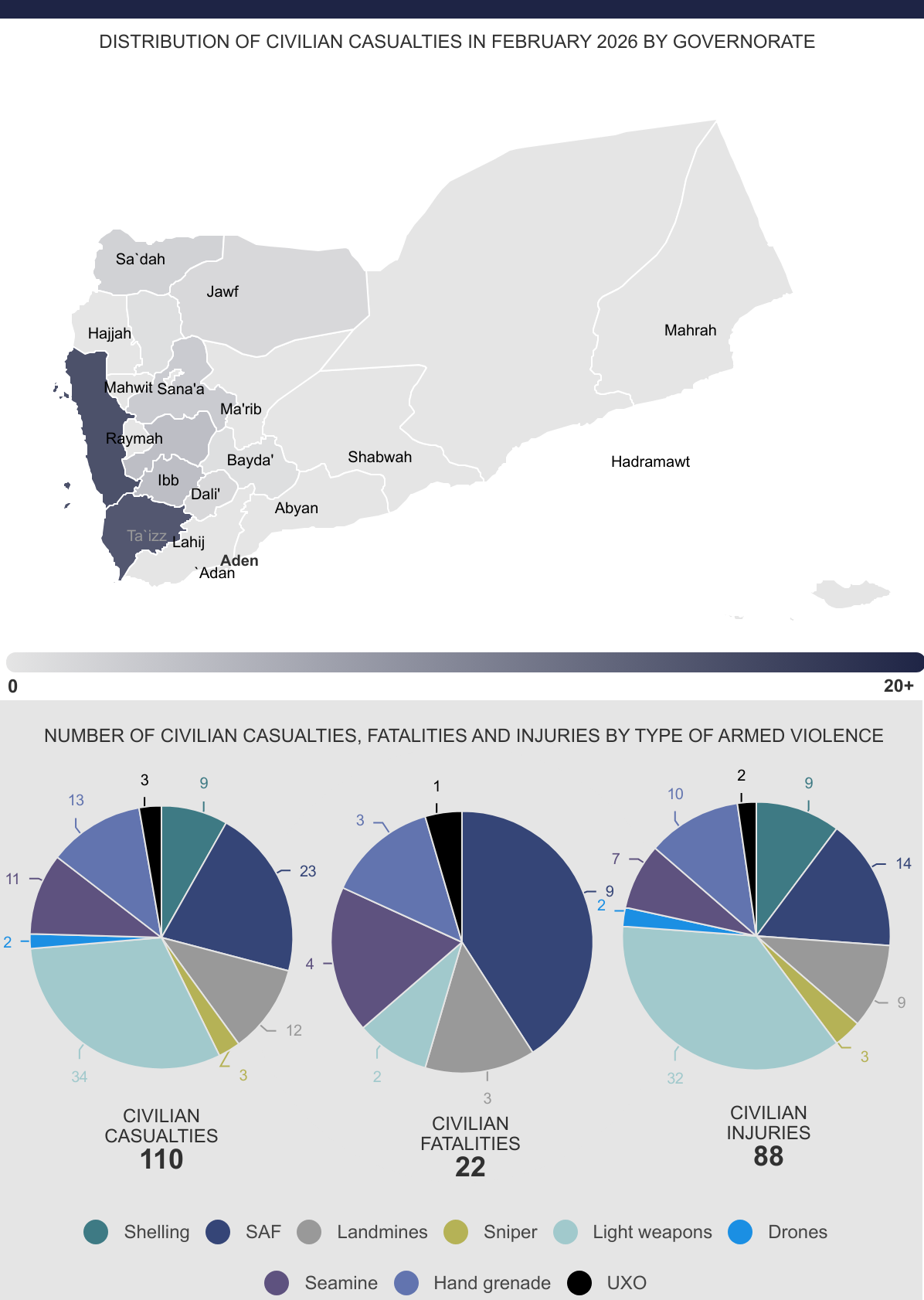
Isolated shootings (23 casualties) and hand grenade incidents (13 casualties) accounted for a third of February’s casualties, a number similar to the previous month and only slightly lower than the monthly average for the past six months (40). The deadliest incident was reported in Taizz, where a hand grenade was detonated inside a house, killing and injuring 9 people. 4 more civilians were shot following a dispute, also in Taizz, marking the highest number of civilian casualties in the governorate caused by isolated incidents since June last year.
The main reasons for the high monthly SAF numbers have not changed: the proliferation of small arms and other weapons, coupled with a weak rule of law. As such, it is expected that the coming period will witness similar levels of violence involving small arms fire (SAF) as there have been no indications that the underlying factors will be addressed.
February saw the highest ERW casualty toll in almost 18 months
Compared to recent months, February saw a spike in Explosive Remnants of War (ERW) casualties (26), almost three times the total reported in January (7) and the highest monthly tally since August 2024. The majority of the casualties (23) were recorded in Al Hudaydah, with the rest in Taizz (2) and Sadah (1). In one incident off the shores of Ad Durayhimi district to the south of Al Hudaydah city, a sea mine explosion killed 4 fishermen and injured at least 7 more, with some estimates putting the total number of deaths and injuries at 14, but exact numbers are still unknown, as some of the victims were lost at sea. This month’s sea mine incident marked the second ERW explosion at sea in the last three months; previously, a sea mine detonation in the Red Sea caused 3 civilian casualties in mid-October.
CIMP has now recorded 8 sea mine explosions since 2018, resulting in 41 civilian casualties, all off the Al Hudaydah coast. February’s incident marked the highest number of victims since mid-2018. The spike in the past few months, though, seems fairly random and not related to an overall increase in ERW caused by recent hostilities, but rather a result of an increase in casualty numbers in each incident, as exemplified by the sea mine explosion in Ad Durayhimi.
The month witnessed an increase in security campaigns in the north of the country
A total of five security campaigns were reported throughout February. In Al Bayda, two campaigns were mobilised: one in Rada city and one in Ash Sharyah district, just to the east of Rada. The governorates of Al Mahwit, Dhamar, and Sanaa also saw additional security forces deployed. There were no civilian casualties in any of the campaigns, but several combatants were killed and wounded. All of the deployments were related to land disputes between local armed groups, with security personnel deployed to mediate an end to the hostilities. However, in each incident, the clashes quickly escalated to involve the security forces, only for local armed groups to turn against the intervening forces.
The only exception has been the campaign in Rada, where security forces were deployed in response to an unresolved issue that has been simmering in Rada city since March 2024, when security personnel were involved in the death and injury of some 20 civilians. Since then, on-and-off clashes have been breaking out between tribal groups and local security, with this month’s casualties confined to 1 combatant shot dead.
Although no civilian victims have been reported in any of these campaigns, the deployment of security personnel has escalated each situation, leading to restricted freedom of movement, an increased security presence along main access points, and a heightened risk of checkpoint violence, especially in areas where the security forces have previously been engaged in armed confrontations with local armed groups.
Insecurity and political tensions continued throughout the south
Instability in the south continued throughout February, leading to clashes, protests, and large political rallies. On 11 February, armed clashes in Ataq city left dozens of people dead and wounded, including at least 4 children aged between 10 and 15 years. The shootings came after a peaceful protest in the city turned violent as demonstrators approached the local authority building, where shooting broke out with security personnel. The latest estimates on casualty numbers indicate that as many as 35 people were killed and injured in the incident, the majority of whom were allegedly involved in the exchange of fire.
A few days later, on 19 February, a political protest opposing the return of the recently-formed government to Aden gathered outside the Presidential Palace. The demonstration, though, turned violent when protesters allegedly attempted to enter the building. The security forces used live ammunition to push them back, with the latest estimates indicating that as many as 45 people, both protesters and soldiers, were killed or injured in the shooting.
Then on 21 February, in the first incident to directly affect civilians in Sayun since the airport bombings in early January, an IED explosion targeted a security vehicle, injuring 1 soldier. Although there were no civilian casualties in the blast, nearby vehicles were damaged.
Given the fragile security situation in the south, it is likely that protests and political rallies could lead to more incidents involving security personnel, especially if soldiers feel threatened or start firing to disperse crowds.
|
|
|
|
|
|
|
|
|
|
|
|
|
|
|
The Civilian Impact Monitoring Project is a monitoring mechanism for the collection, analysis and dissemination of open source data on the civilian impact from armed violence in Yemen, in order to inform and complement protection programming.
|
|
|
|
|
|
|
Click here to subscribe to our flash, daily and weekly reporting,
or visit our website here.
For further information, please contact us at contact@civilianimpact.org.
|
|
|
|
|
|
|