|
|
|
|
This is the Civilian Impact Monitoring Project's monthly visual and analytical report, providing an overview of all incidents of armed violence reported to have directly impacted civilians in Yemen in July 2026. The report covers civilian casualties, incident distribution, types of armed violence, and impacts on civilian property and infrastructure.
|
|
|
NATIONWIDE SNAPSHOT: CIVILIAN IMPACT FROM INCIDENTS OF ARMED VIOLENCE
|
|
|
|
|
|
|
Civilian Impact Incidents
Civilian Casualties* (Fatalities / Injuries)
Child Casualties (Fatalities / Injuries)
Women Casualties (Fatalities / Injuries)
|
|
|
|
|
|
74
103 (31 / 72)
23 (6 / 17)
12 (4 / 8)
|
|
|
|
|
|
|
Compared to previous month
|
|
|
|
|
|
Compared to 2026 monthly average
|
|
|
|
|
|
|
|
|
*Please note, all information and numbers included in CIMP reporting are based on information publicly available in open sources, and have not been independently verified
|
|
|
|
|
|
|
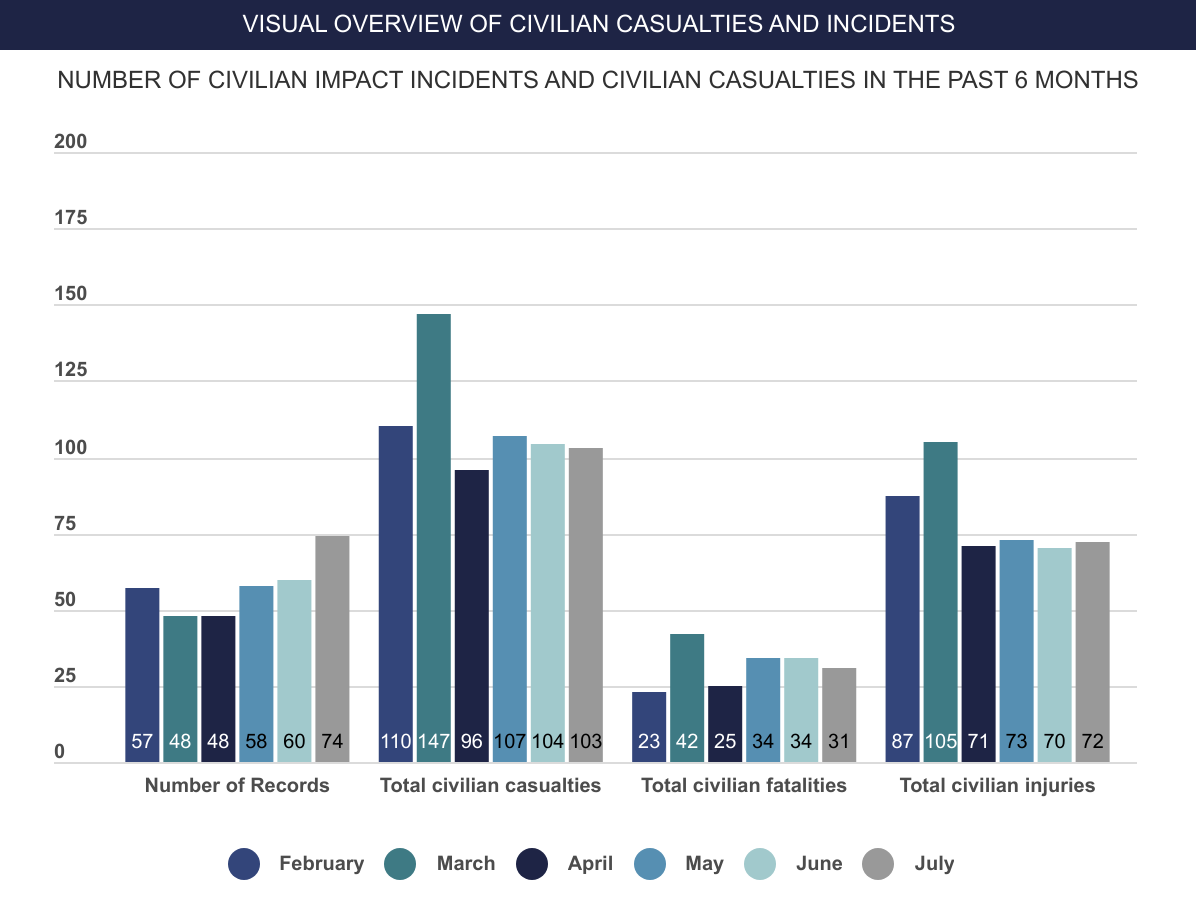
Civilian casualty numbers have remained steady for the past three months
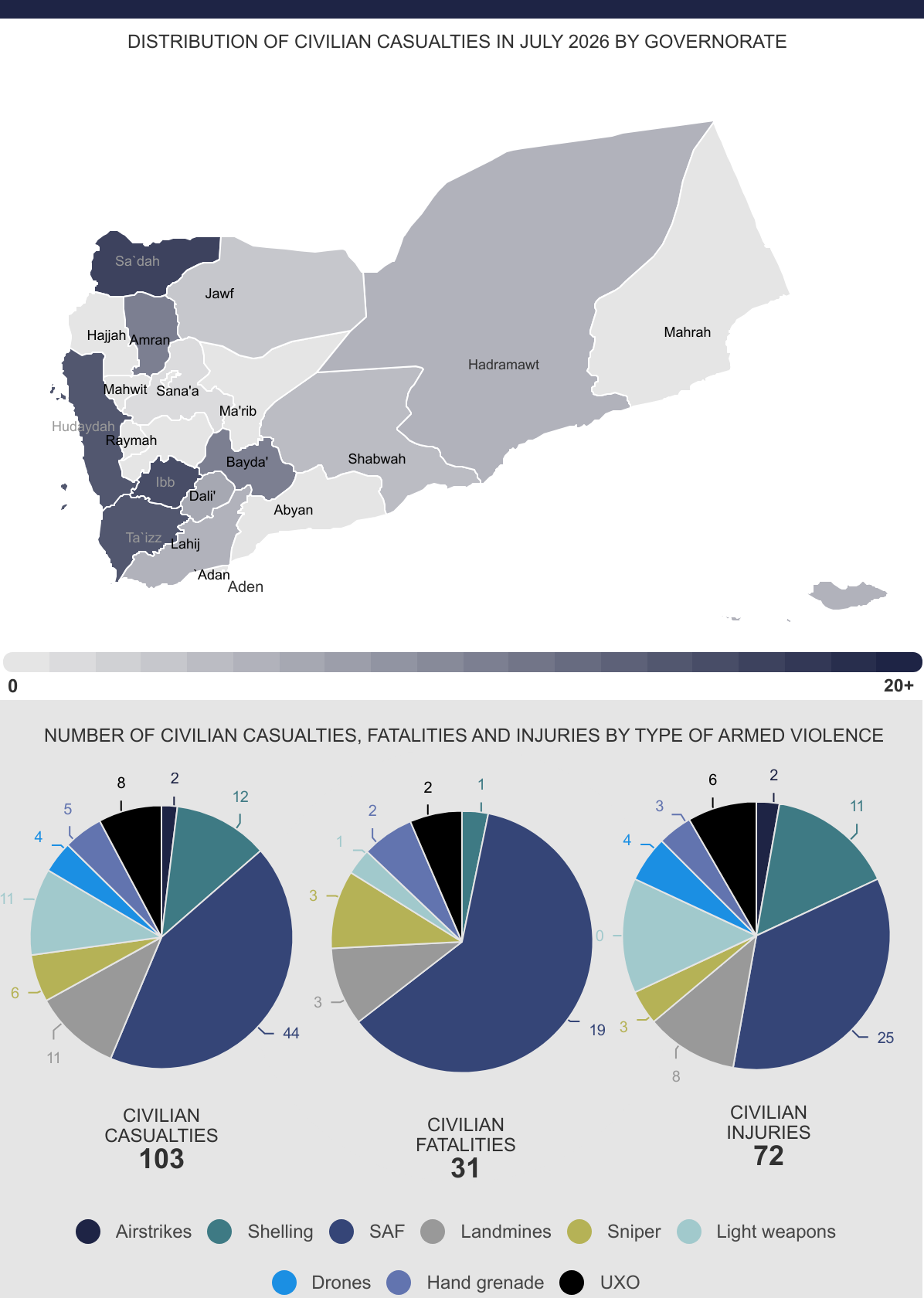
Although July saw a relative escalation in military activity compared to May and June, civilian casualty numbers (103) have remained consistent over the past three months (107 and 104). Despite the increase in hostilities, July actually witnessed the second lowest monthly casualty total this year after April (96), mainly because of a drop in isolated incidents involving small arms fire (SAF) and hand grenades. However, casualties among children and women were the third highest this year (35) after March (43) and June (38), driven primarily by Explosive Remnants of Warfare (ERW) (13) and SAF (9) incidents.
As hostilities also heated up in the wider region, cross-border attacks resumed. However, the warring parties’ focus appears to have shifted from broader regional dynamics to narrower domestic demands, including reopening Sanaa airport, resuming oil and gas exports, and wartime reparations. Combined with the rising tensions on the frontlines, there is a growing risk of the 2022 UN-sponsored truce breaking down and the war restarting, dramatically increasing the exposure of civilians to armed violence in the coming months.
Airstrikes in July marked the second aerial escalation in 2026
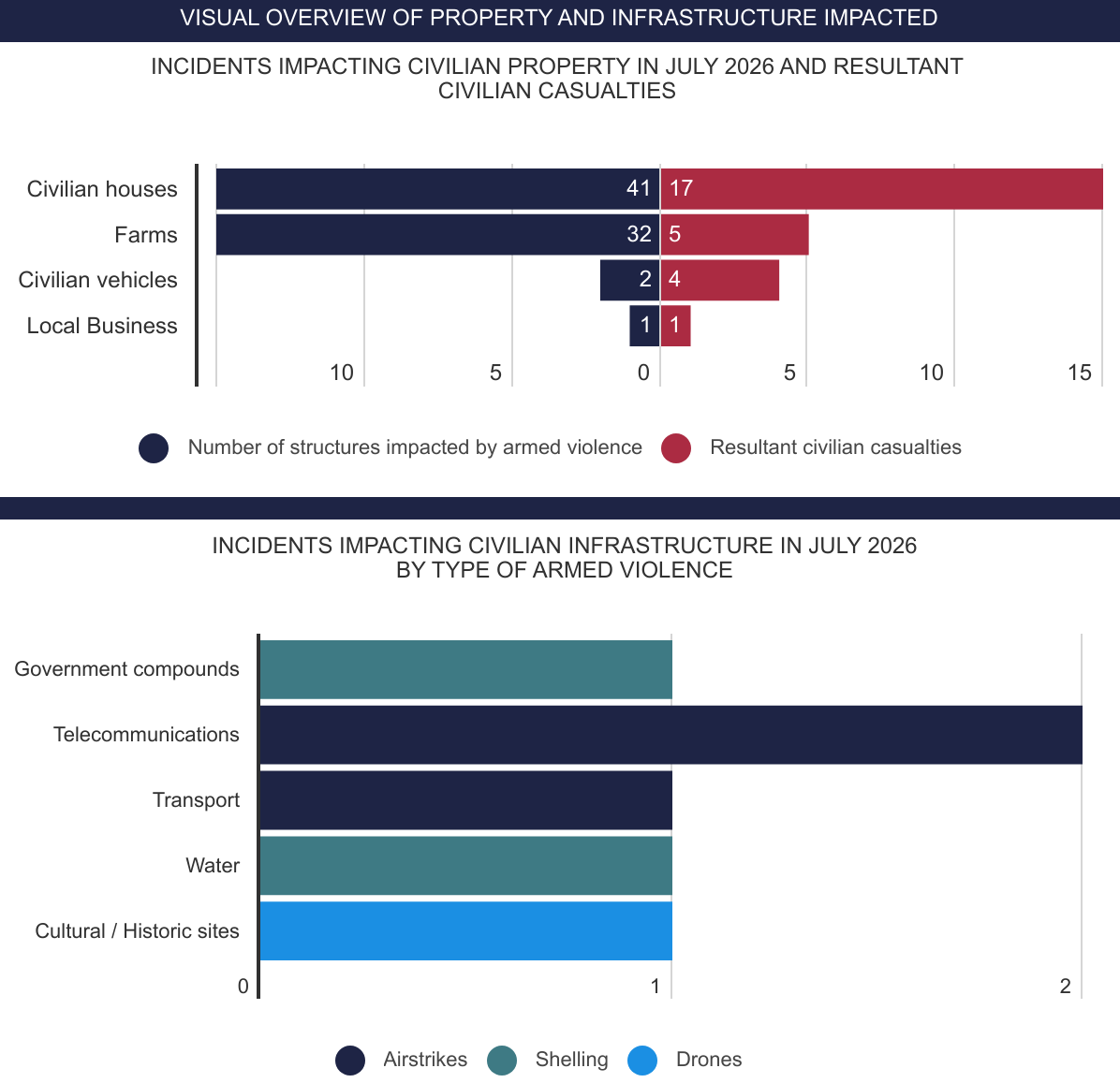
July marked the second time this year that civilians have been impacted by airstrikes, following the brief outburst of bombing on the south of the country in January. The latest strikes injured 2 civilians, both in the western districts of Al Hudaydah: 1 in Al Hudaydah city and 1 on Kamaran Island. The strikes targeted telecommunications infrastructure in the coastal governorate on 23 July, after hitting Sanaa Airport 10 days earlier. The air raids started in an attempt to prevent the landing of a civilian aircraft in Sanaa on 13 July, and resumed once again on Al Hudaydah following cross-border drone and missile launches and maritime attacks against commercial ships in the Red Sea.
Following the two rounds of airstrikes, there has been no further aerial escalation or major military moves to shift existing frontlines on the ground. Reports indicate that the strikes were intended to be limited and that there were no plans at the time to expand the range of targets to include civilian infrastructure, including the As Salif seaport and the Al Hudaydah city seaports. Nonetheless, if the tempo and scale of cross-border and Red Sea drone and missile launches increase, there is a strong chance that more intensive retaliatory strikes may resume in the coming period.
Heightened frontline violence continued, causing a slight increase in civilian casualties
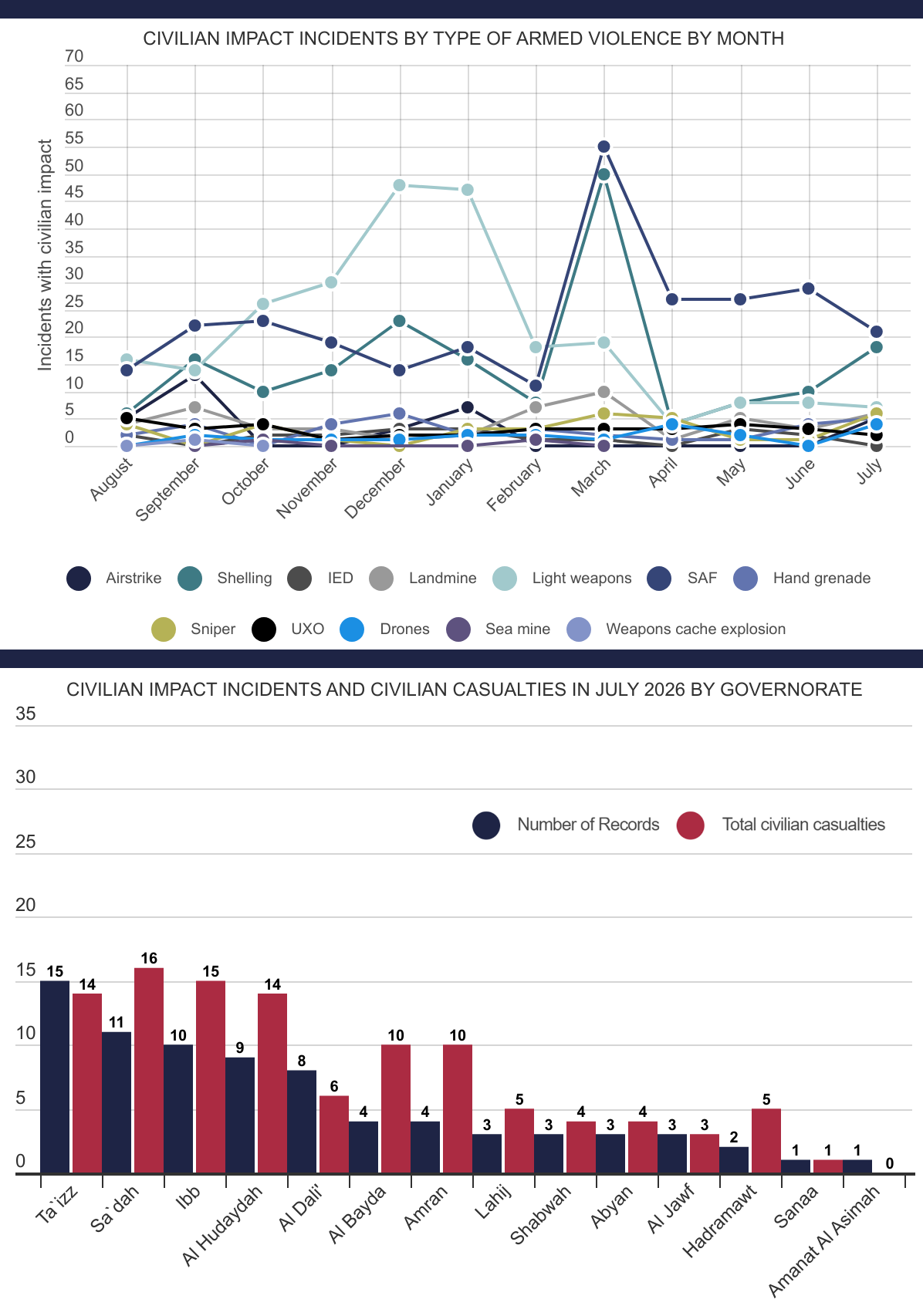
Frontline hostilities were responsible for a third of the month’s civilian casualties (30), a similar number to June (29) and May (31). As in the past three months, Sadah saw the majority of casualties countrywide, with the governorate accounting for over half (53%) of all frontline casualties (16) in July. Overall, though, civilian deaths and injuries were distributed over seven governorates, the widest geographical expanse of frontline activity affecting civilians this year, and the most widespread since May 2025.
July also saw the second highest monthly count of civilian frontline victims reported in Taizz so far in 2026 (8), the second most in the governorate in the past 12 months. The fighting also led to civilian casualties in Ad Dali (3), Al Bayda (2), Al Hudaydah (1) and damage to civilian structures in Al Jawf and Lahij as the clashes continue to spread. The month witnessed fighting on a near-daily basis, with bouts of intense hostilities in southern Al Hudaydah, northern Ad Dali, and to the south of Marib, leaving dozens of combatants dead and wounded. It is expected that frontlines will continue to experience intensive violence in the coming period, raising the risk that fighting may reach closer to civilian areas.
Casualties caused by isolated incidents fell by a third compared to June
Nearly half (48%) of the month’s casualties (49) were the result of shootings and hand grenade explosions, with Ibb alone witnessing a third (31%) of the dead and injured (15). In total, July saw the third-lowest monthly count of isolated incidents after January (36) and February (36), down 10% from June (55). A quarter (24%) of the casualty toll (12) were children and women, representing a drop of around a third compared to a month earlier (18), but marking the second most casualties among children and women after ERW this month. This brings civilian casualties from shootings and hand grenade explosions up to 348 casualties for the year, a number around 40% more than the same period last year (245). Geographically, Taizz has now seen the highest number of civilian casualties because of small arms fire (SAF) and hand grenades in 2026 (51), followed by Amran (48) and Ibb (46).
ERW casualties were slightly higher than the monthly average for 2026
The reporting period saw a similar number of civilian victims from Explosive Remnants of Warfare (ERW) (19) to the previous month (20), although around 20% lower than May (24). Still, the number was higher than this year’s monthly average (17). Nearly half (42%, 11) of the casualties were reported in Al Hudaydah, followed by Al Bayda (5), while Amran, Sanaa, and Taizz accounted for a single casualty each. More than two-thirds (68%) of the casualties (13) were children (10) and women (3). This is the highest number of women casualties caused by ERW this year, and the third highest child casualty number after June (16) and March (11).
Around a third (37%) of the casualties (7) were reported in a single incident, when an Unexploded Ordnance (UXO) detonated inside a house in Az Zaydiyah district to the north of Al Hudaydah city. The ordnance was reportedly brought to the house by one of the victims, who mistook the explosive device for reusable material. This is the only the second incident of armed violence to impact civilians in Az Zaydiah since CIMP began recording; previously, airstrikes hit the government compound in the district in 2018.
So far in 2026, the total number of civilians impacted by ERW (119) is slightly higher than in the same period last year (116). This highlights that although the conflict has seen a relative lull in ground hostilities and aerial bombardment in 2026 compared to previous years and frontlines have not changed since the 2022 truce, ERW will continue to pose a threat to civilians, even in populated areas where no active frontlines existed in the past, for many years to come.
Cross-border strikes are likely to continue in the coming period
Although the regional conflict is still ongoing, the focus of cross-border missile and drone strikes from Yemen appears to have shifted in the past month. Following renewed demands to re-open Sanaa airport and pay wartime reparations, a selective blockade of the Bab Al Mandab Strait was imposed on 20 July. As such, missile and drone strikes from Yemen will likely continue, both across the northern border and against ships transiting the Bab Al Mandab Strait.
Although no airstrikes have been reported since 25 July, the continuation of cross-border launches will increase the possibility of retaliatory airstrikes in the coming month, carrying the risk of civilian casualties, especially if strikes target heavily populated areas. At the same time, frontline hostilities appear to be heading toward significant escalation. So far, the fighting has not led to a shift in the current lines of control, and none of the parties to the conflict have declared an end to the 2022 truce, but all indications suggest the ground conflict is heating up to the highest level in the past four years.
|
|
|
|
|
|
|
|
|
|
|
|
|
|
|
The Civilian Impact Monitoring Project is a monitoring mechanism for the collection, analysis and dissemination of open source data on the civilian impact from armed violence in Yemen, in order to inform and complement protection programming.
|
|
|
|
|
|
|
Click here to subscribe to our flash, daily and weekly reporting,
or visit our website here.
For further information, please contact us at contact@civilianimpact.org.
|
|
|
|
|
|
|