|
|
|
|
This is the Civilian Impact Monitoring Project monthly visual and analytical report, providing an overview of all incidents of armed violence reported to have had a direct impact on civilians in Yemen in December 2025. The report covers civilian casualties, incident distribution, type of armed violence and impact upon civilian property and infrastructure.
|
|
|
NATIONWIDE SNAPSHOT: CIVILIAN IMPACT FROM INCIDENTS OF ARMED VIOLENCE
|
|
|
|
|
|
|
Civilian Impact Incidents
Civilian Casualties* (Fatalities / Injuries)
Child Casualties (Fatalities / Injuries)
Women Casualties (Fatalities / Injuries)
|
|
|
|
|
|
101
157 (35 / 122)
18 (7 / 11)
10 (6 / 4)
|
|
|
|
|
|
|
Compared to previous month
|
|
|
|
|
|
Compared to 2024 monthly average
|
|
|
+ 503%
+ 178%
+ 129%
+ 114%
|
|
|
|
|
|
|
*Please note, all information and numbers included in CIMP reporting are based on information publicly available in open sources, and have not been independently verified
|
|
|
|
|
|
|
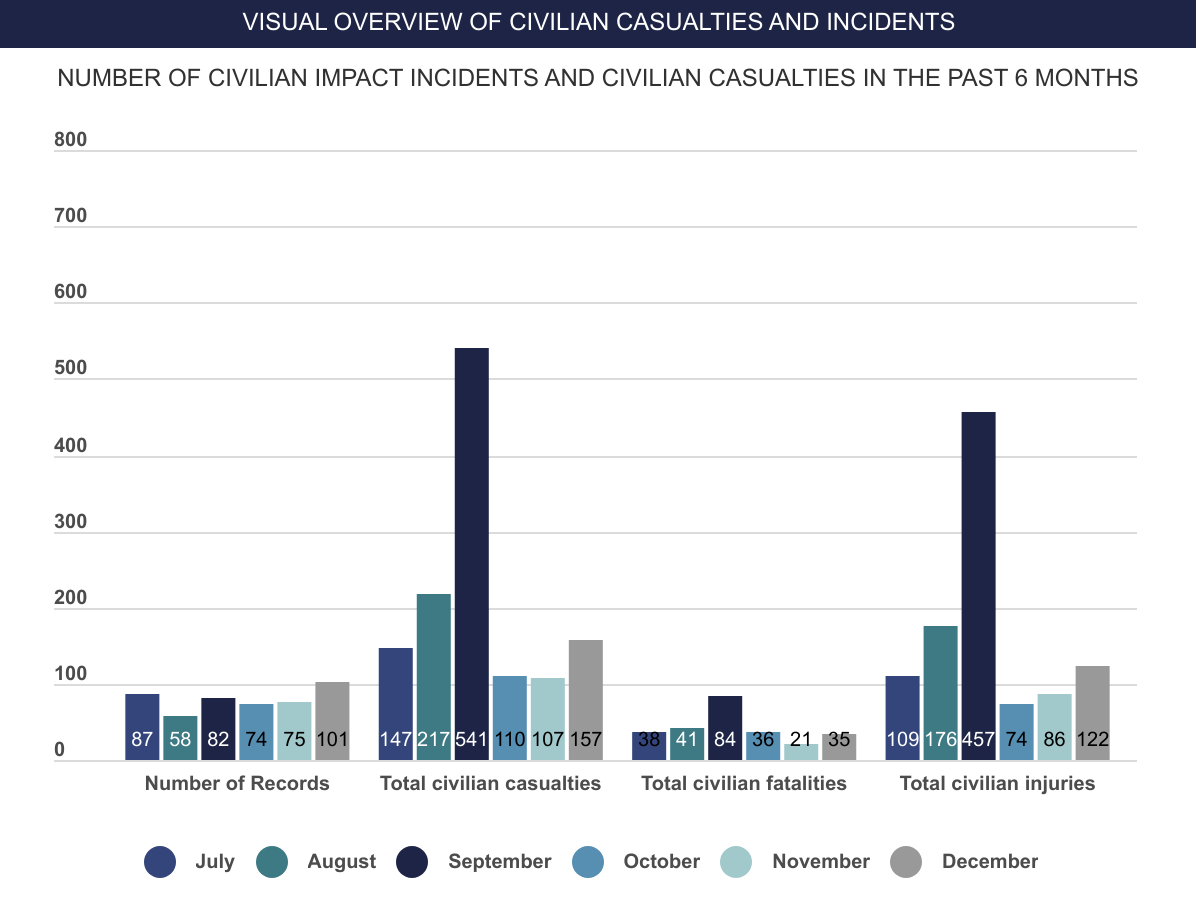
Casualty numbers spiked to the highest in three months
The reporting period saw a total of 157 civilian casualties countrywide, an increase by a third (32%) compared to both November (107) and October (109). The primary reason for the rise has been a spike among frontline casualties along the northern border in Sadah, which saw an increase in deaths and injuries (99) by around 50% compared to the month before (55). Children and women casualties (28) also more than doubled from November (12), marking the highest monthly number in two months. Furthermore, by the end of December, airstrikes were reported in Hadramawt, but with no resultant civilian casualties, ending two consecutive months with no air raids on the country, the longest pause in almost two years.
Around half (15) of the month’s children and women casualties were caused by hand grenade explosions (8) and small arms fire (7), both assessed to be isolated and unrelated to the overall conflict. ERW incidents, meanwhile, led to an additional 7 children and women casualties, followed by 6 as a result of heavy artillery fire impacting civilian areas in Taizz and Sadah, marking the first time in over a month that children and women were affected by frontline violence in Sadah.
Frontline violence accounted for two-thirds of the month’s civilian deaths and injuries
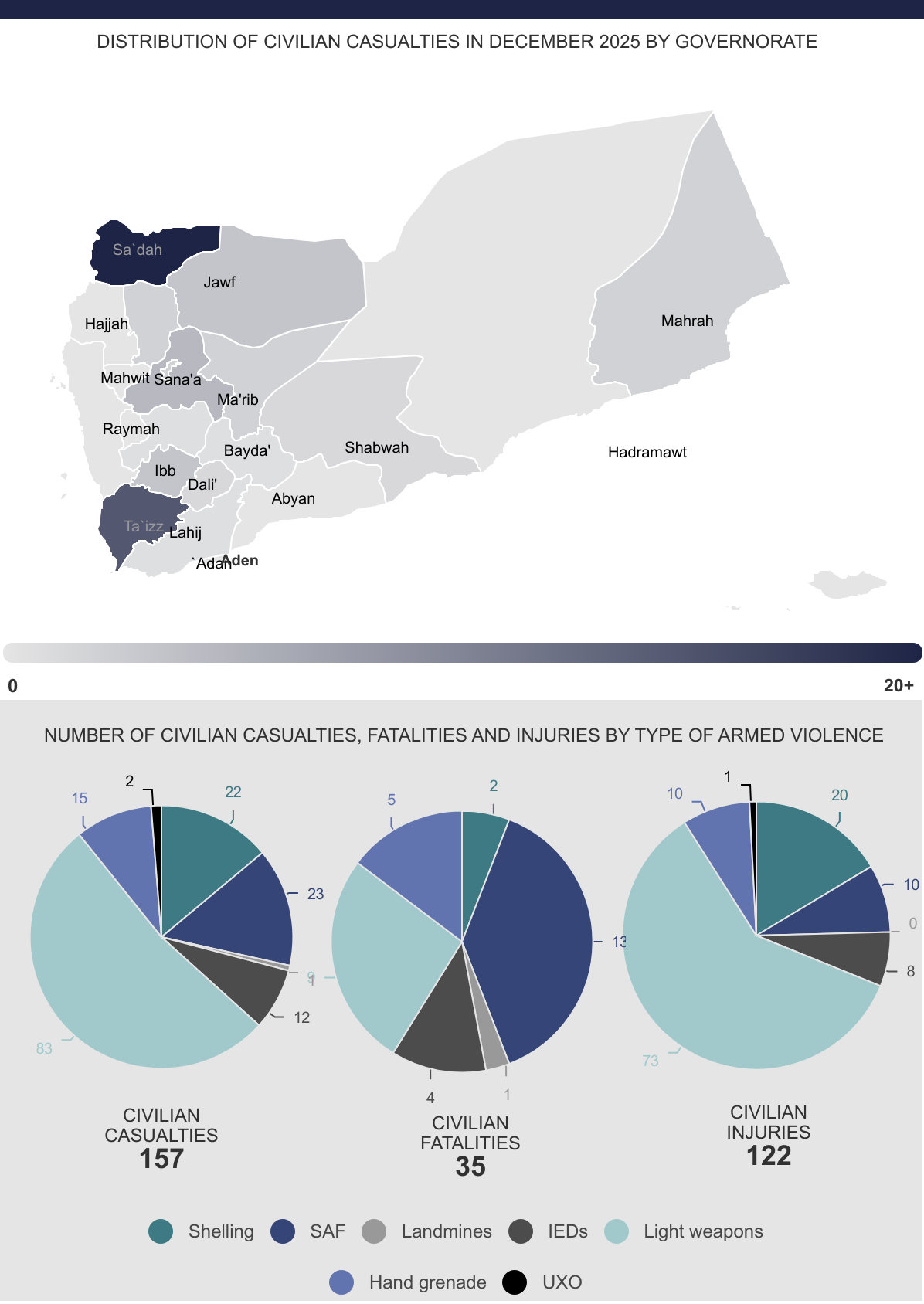
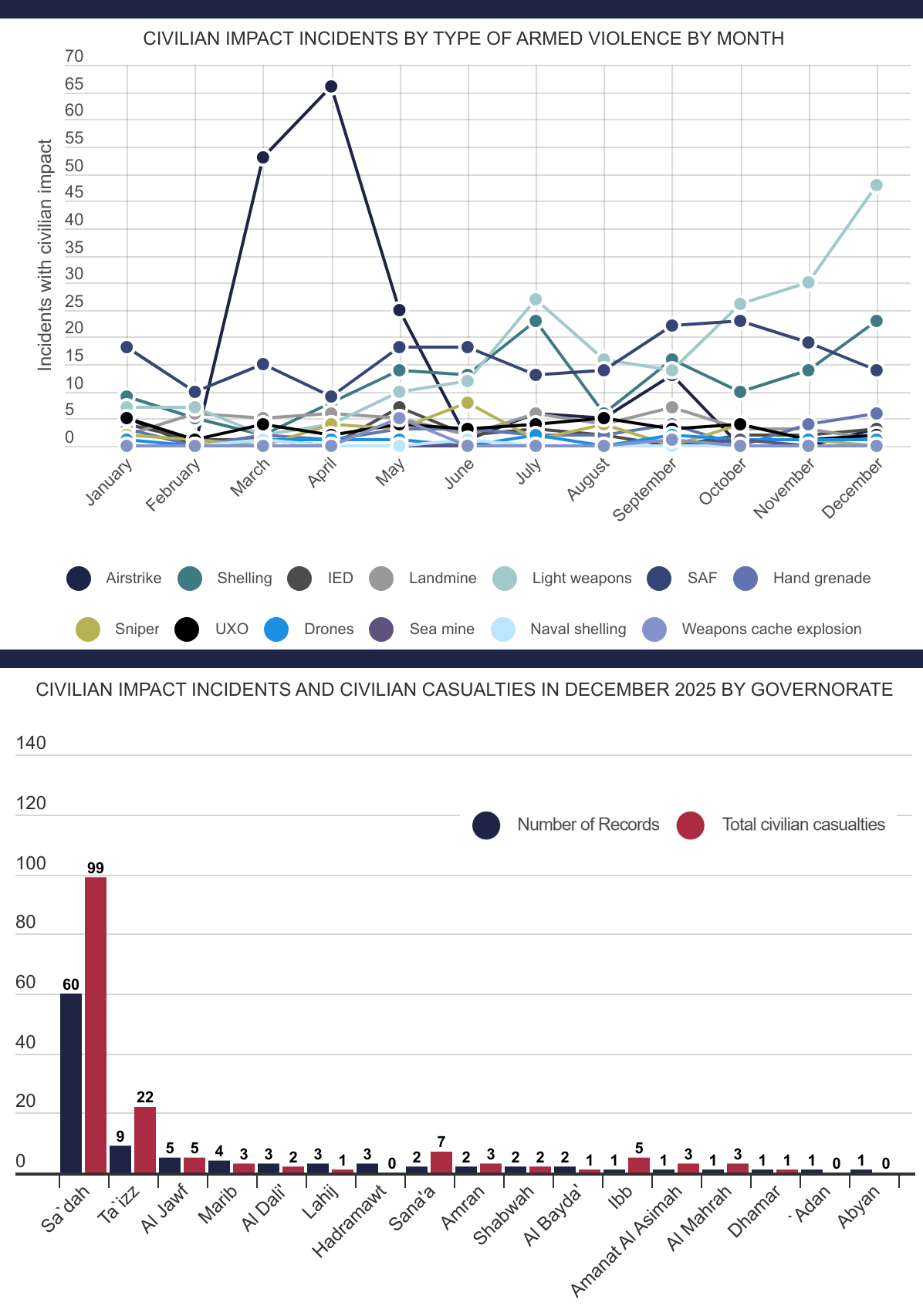
December’s casualties along the country’s active frontlines totalled 104, two-thirds of this month’s total civilian casualties (157), around 40% more than November (60), and the highest monthly number since July (106). In particular, Sadah witnessed an escalation along its northern borders, with casualties spiking to 99, the highest monthly count in the governorate in 2025, excluding casualties caused by airstrikes. Monabbih accounted for the majority of the casualties (37), followed by Shadaa (31), Qatabir (23), Razih (7), and Baqim (1). Around half of the casualties (41) in Sadah were migrants, the most recorded in a single month since airstrikes hit a detention centre in April, causing 133 migrant deaths and injuries.
Another 5 civilians were the victims of frontline violence in Taizz. The casualties were reported in the eastern outskirts of Taizz city (2) and on the southern border of the governorate with Lahij (3). There were no frontline civilian casualties on any of the other active frontlines, although in Harib district to the south of Marib, there were reports of heavy artillery fire impacting villages, damaging houses in the area.
It is assessed that the increase in casualty numbers in Sadah is related to a spike in attempted border crossings, especially by migrants. This is partly explained by the fact that over 80% of the casualties (82) in the governorate were the result of light weapons fire, suggesting a pattern of targeting lone individuals rather than coordinated campaigns against civilian areas or infrastructure using heavy artillery or drone strikes.
Hand grenade explosions caused 8 children and women casualties
December saw hand grenade victims jump to 15, the highest in six months. In a single incident in Taizz, 1 child was killed, and 4 other children were injured while playing with a grenade. In Al Mahrah, 1 woman and 2 children were killed after tampering with the ordnance inside their home. The two incidents brought the number of children impacted by hand grenade explosions to 7, the highest monthly total for children this year. Another 7 civilians were killed or injured by hand grenades in Ibb and Dali following disputes.
In 2025, a total of 78 civilians were killed or injured by hand grenade explosions. Over half of that number (44; 56%) were reported to have occurred inside houses (29; 37%) or during wedding gatherings (15; 19%). In addition to that, 40% (31) of the hand grenade victims this year have been women and children, either due to family disputes or accidental detentions.
December marked the lowest SAF incident rate in four months
A total of 23 civilians were killed and injured by small arms fire (SAF) in December, marking the lowest count in four months and the fourth lowest this year after April (9), July (18), and May (21). December is also the third consecutive month that shooting victims have been trending downwards. Nonetheless, 20% of the reported casualties were children and women, the fourth highest count among children and women this year.
Around half of the casualties (10) were reported in Sanaa city, while Al Jawf, Amran, and Marib each reported 3 casualties. Still, shootings were the second leading cause of civilian casualties this month after frontline violence. Although there has been an observed incremental decrease in small arms fire (SAF) victims over the past few months, the total number of shooting casualties this year (374) has been the second-highest annual total since 2021 (420). Specifically, January (47), June (46), August (43), and September (41) saw the highest SAF incidents, contributing to the increase seen across 2025.
80% of ERW victims in December were children and women
An IED explosion in Taizz in December resulted in 12 civilian casualties, accounting for 80% of the month’s Explosive Remnants of War (ERW) victims (15). Among those killed and injured were 3 children and 1 woman. Landmine explosions also resulted in the death of 1 child in Lahij, while 2 women were killed and wounded following landmine explosions in Al Jawf. 40% (81) of all ERW casualties this year (200) have been women and children, with Taizz accounting for 16 children and women casualties, followed by Al Hudaydah (13), Al Jawf (12), and Lahij (11).
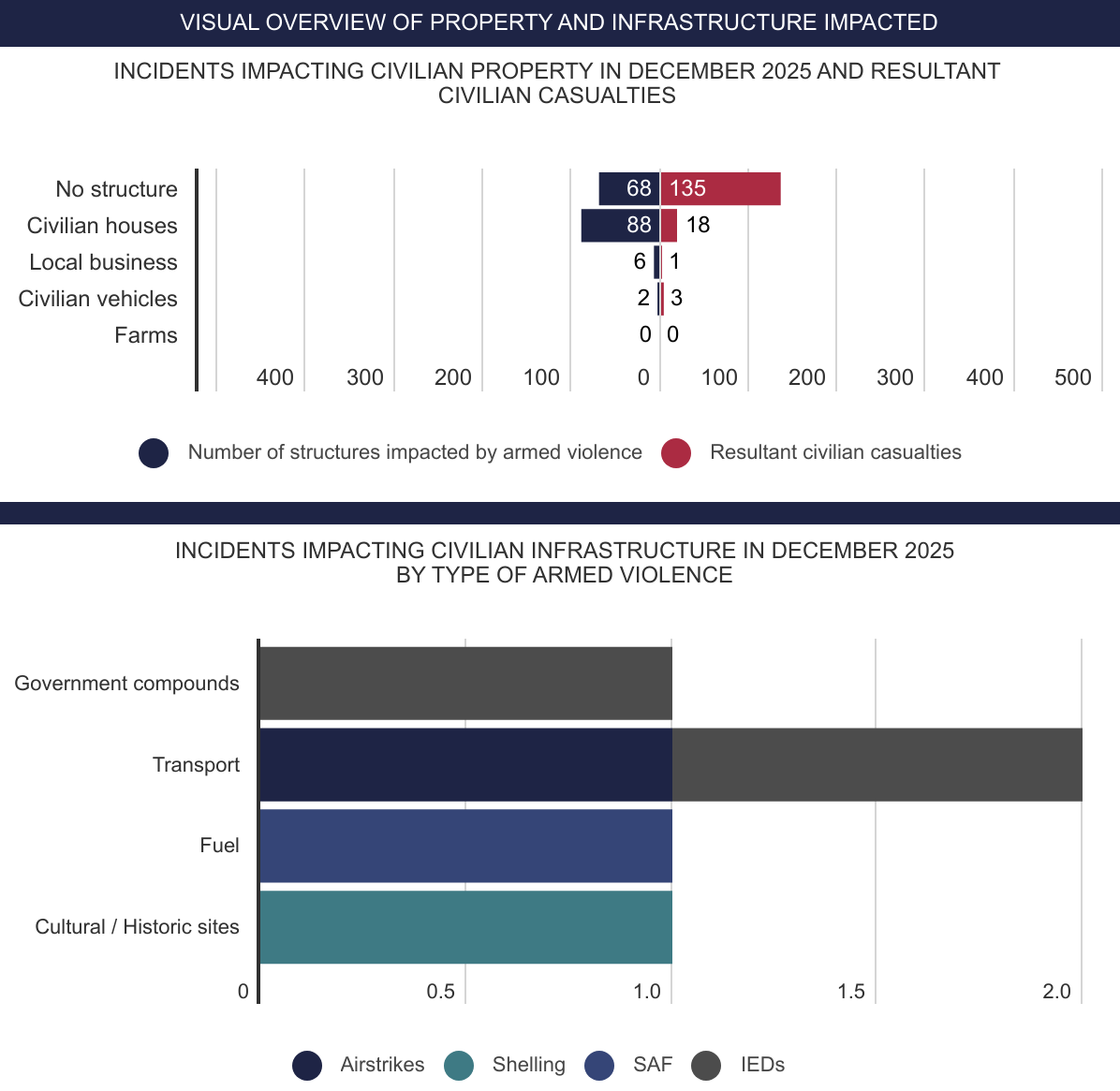
In Mukayras, a main road connecting Al Bayda to Abyan was sabotaged using explosives earlier this month, an incident assessed to be in response to the recent widespread military developments in the south of the country. The intent appears to have been to cut off the route, which crosses an informal internal border and was only recently reopened. Despite the increasing tempo of political and military tensions in the south throughout the month, no further road closures were reported on main roads in Al Bayda, Marib, or Taizz that serve as critical connections between the north and south of the country. However, should hostilities re-escalate, then these roads and other key routes will likely see significant disruption.
Political and military tensions continued in Hadramawt, leading to airstrikes on Al Mukalla City
7 civilian injuries were reported between 3 and 7 December, in addition to as many as 102 military casualties, as tensions in the eastern governorate boiled over in armed clashes and airstrikes. Widespread military deployments continued throughout the month, with forces moving eastward from Abyan, Aden, and Shabwah into the coastal areas of the governorate and the central Sayun district.
Then, on 30 December, airstrikes hit the Al Mukalla seaport on the Hadramawt coast, marking the first major civilian infrastructure to be impacted by the recent hostilities in the governorate, and the first time that airstrikes have targeted the port. No civilian casualties were recorded, but the strikes reportedly impacted nearby houses and shops. However, despite the bombings, there were no disruptions to the port’s operations, which resumed the following day.
By the end of the month, intermittent clashes were reported across the governorate, with as many as 25 combatants reportedly killed and injured in clashes in Ash Shihr to the east of Al Mukalla City on 26 December. Airstrikes were then reported on the same day against military sites in Ghayl Bin Yamin in response to ongoing fighting and deployments, with no resultant casualties. The escalation in the governorate continued into January, although the situation has calmed somewhat, with no more confrontations reported since 5 January, but tensions remain, and the risk of further armed violence remains.
There was an increase in VEO activity, but no civilians were directly impacted
Multiple VEO-related incidents were reported throughout the month in Abyan, Shabwah, Marib, and Hadramawt, but the impact on civilians has been limited. In Marib, drone strikes reportedly hit a house in which alleged VEO operatives were stationed, killing at least 2 people and damaging the building, on 8 December. Roadside IED explosions and drone strikes have been the primary type of incidents impacting military forces, especially on main roads and military installations, in the month.
Following recent developments in Hadramawt and neighbouring governorates, there is a slight possibility that VEO activity may increase in the coming period, especially around military checkpoints and bases in Abyan, or along highways in Marib, Abyan, and Shabwah leading to Hadramawt, where convoys are passing. Any incidents on the routes would restrict the freedom of movement for civilians travelling along the main roads between the governorates, including the southern coastal highway running from Aden to Al Mukalla and inland roads connecting to the country’s northern and eastern borders.
|
|
|
|
|
|
|
|
|
|
|
|
|
|
|
The Civilian Impact Monitoring Project is a monitoring mechanism for the collection, analysis and dissemination of open source data on the civilian impact from armed violence in Yemen, in order to inform and complement protection programming.
|
|
|
|
|
|
|
Click here to subscribe to our flash, daily and weekly reporting,
or visit our website here.
For further information, please contact us at contact@civilianimpact.org.
|
|
|
|
|
|
|