|
|
|
|
This is the Civilian Impact Monitoring Project's monthly visual and analytical report, providing an overview of all incidents of armed violence reported to have directly impacted civilians in Yemen in August 2026. The report covers civilian casualties, incident distribution, types of armed violence, and impacts on civilian property and infrastructure.
|
|
|
NATIONWIDE SNAPSHOT: CIVILIAN IMPACT FROM INCIDENTS OF ARMED VIOLENCE
|
|
|
|
|
|
|
Civilian Impact Incidents
Civilian Casualties* (Fatalities / Injuries)
Child Casualties (Fatalities / Injuries)
Women Casualties (Fatalities / Injuries)
|
|
|
|
|
|
187
203 (68 / 135)
35 (12 / 23)
21 (4 / 17)
|
|
|
|
|
|
|
Compared to previous month
|
|
|
|
|
|
Compared to 2026 monthly average
|
|
|
|
|
|
|
|
|
*Please note, all information and numbers included in CIMP reporting are based on information publicly available in open sources, and have not been independently verified
|
|
|
|
|
|
|
Civilian casualty numbers double as fighting enters a new phase
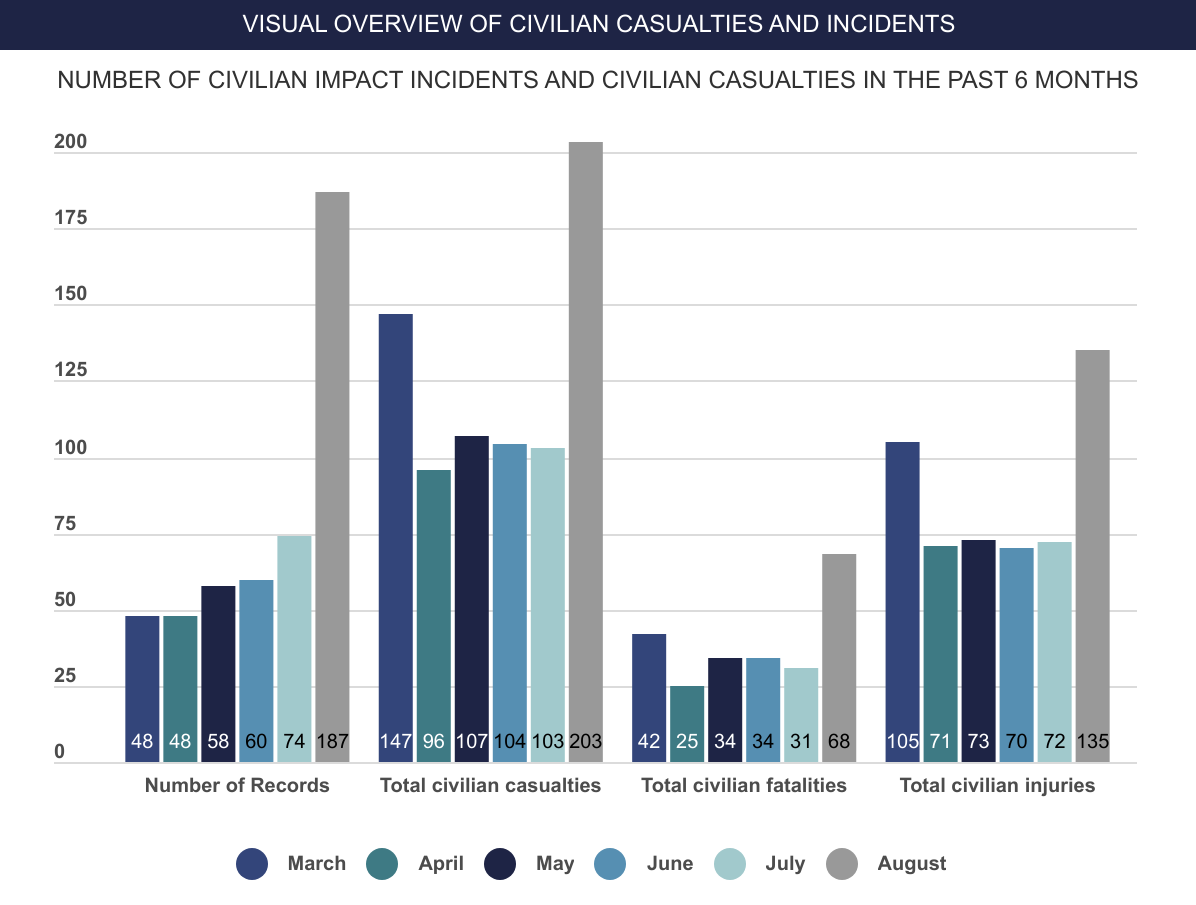
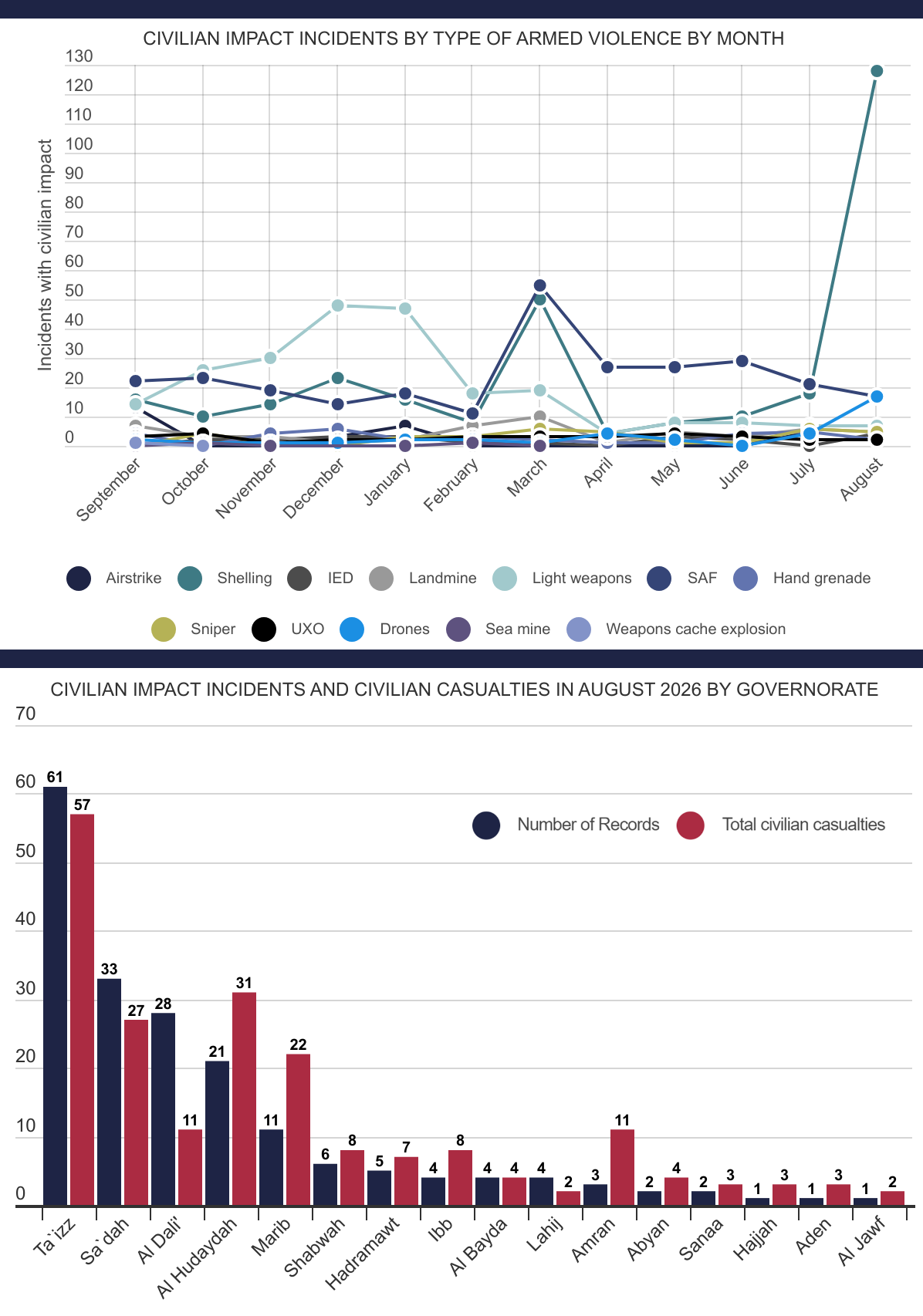
August saw civilian casualty numbers almost double (203) compared to a month earlier (103), marking the highest monthly toll since September 2025. The main reason for the spike in casualties was the resumption of drone and missile strikes against civilian infrastructure as the fighting entered a new phase. In addition to the escalated attacks in Yemen, cross-border strikes also continued, hitting both oil and gas infrastructure, as well as targeting shipping in the Red Sea.
As part of the rising casualty figures, child and women casualties more than doubled (60%, 56) compared to July (35), accounting for around a fifth (17%) of the total casualty toll. Frontline violence, excluding airstrikes, was the source of almost a third of the child and women casualties (30%, 40), the most caused by the hostilities since May of last year. The remaining casualties during August were the result of isolated shootings (40) and ERW explosions (30), nearly a quarter of whom (23%, 16) were children and women.
The increase in civilian casualties looks set to continue in the coming month as the focus of the warring parties has shifted from the broader regional conflict to the home front. The coming period is likely to witness more strikes against civilian infrastructure, both in Yemen and across the northern border, which will likely provoke retaliatory airstrikes, raising the risk for civilians, especially along the re-activated frontlines on the west coast and in major population centres.
Two thirds of the casualties caused by frontline hostilities
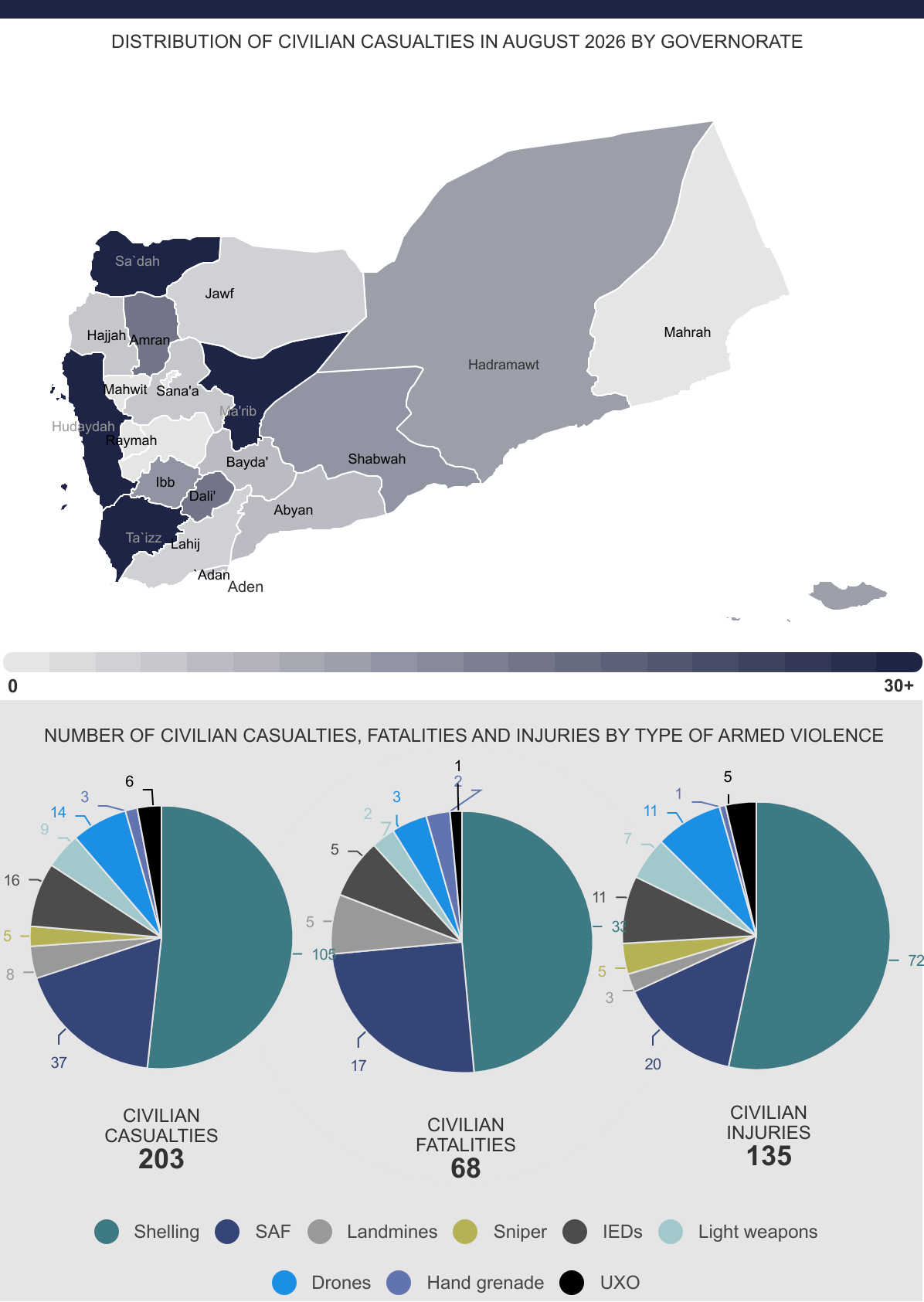
Civilian casualties from frontline violence saw a sharp increase in August (133), jumping almost fourfold compared to July (33). Overall, the fighting accounted for two-thirds of the month’s casualties, the highest number of civilians killed and injured by frontline hostilities since January 2023. Taizz was the primary hotspot for the fighting and, as a result, saw around half (41%, 57) of all civilian casualties reported during the month. In particular, the western governorate saw two mass casualty events: missile strikes on the Al Mukha seaport on 9 August left 18 civilians dead and wounded, and another 11 civilians were hurt in an 11 August attack on the Al Urdi port, off the Bab Al Mandab Strait.
The use of drones and missiles on civilian sites was a feature of the month’s hostilities. In total, the seaport in Al Mukha was targeted four times, resulting in 25 casualties, while strikes also hit civilian areas in Al Mukha city, including houses and the main hospital. Another 19 civilians were killed and wounded in the rest of the governorate as a result of hostilities in the outskirts of Taizz city and on the frontlines in western Maqbanah and Mawza and Hayfan further to the south.
Marib was another focal point for frontline violence in the past month, with missiles hitting houses and IDP camps in and around the governorate capital. 19 civilians were killed and injured in the attacks, the most from frontline hostilities in Marib since January 2022. The majority of the dead and wounded came in a single incident: missiles hitting the eastern outskirts of Marib city on 7 August, killing (2) and injuring (14) as many as 16 civilians. Three IDP camps were also impacted during the violence in Marib city, the first time that IDP settlements have been directly impacted by hostilities in the governorate since May 2024.
And, in Al Hudaydah, the southern districts of Hays and Al Khawkhah saw repeated bouts of shellfire as the conflict spread across the border from southwestern Taizz. 20 civilians were reported killed and injured in the fighting. Around a third of the casualties (30%, 6) were the result of missiles hitting a fishing dock on the Hanish Islands off the coasts of Al Khawkhah on 27 August, all of them seafarers. This came amid a broader increase in attacks on islands and boats off the coast of Al Hudaydah.
The other most active front was in Ad Dali, where frontline violence led to a further 11 civilians being killed and injured. Qaatabah district in the north of the governorate saw the majority of the civilian victims. In total, a third of the civilians killed and injured along the country’s frontlines in August (30%, 40) were children (26) and women (14), the most reported in a single month due to ground fighting since February 2022.
ERW victims marked a two-year high in August, with 30 civilian casualties
Explosive Remnants of War (ERW) resulted in a total of 30 civilians dead and wounded, two-thirds higher than the number reported in July (63%, 19), and the most since August 2024. Despite the increase, only a fifth (20%) of the casualties (6) were children and women, marking the second-lowest proportion of children and women among ERW casualties after February of this year. Nonetheless, ERW victims (149) have already surpassed the ERW casualties reported during the same period in 2025 (136) by around 10%. Children and women casualties have also increased so far in 2026 (69) compared to the same period last year (59), an increase similar in proportion (14%) to the overall rise.
Al Hudaydah saw the highest casualty count (11), followed by Shabwah (6), while Aden and Al Bayda each accounted for 3 casualties. Al Hudaydah has now accounted for nearly half of all the ERW victims in 2026 (42%, 62), 45% more than the governorate saw in all of 2025. This is also three times more than the second-highest governorate this year, Sanaa, where 20 civilians have been reported dead and wounded due to ERW blasts.
The escalated armed violence impacted houses, IDP camps, and critical infrastructure
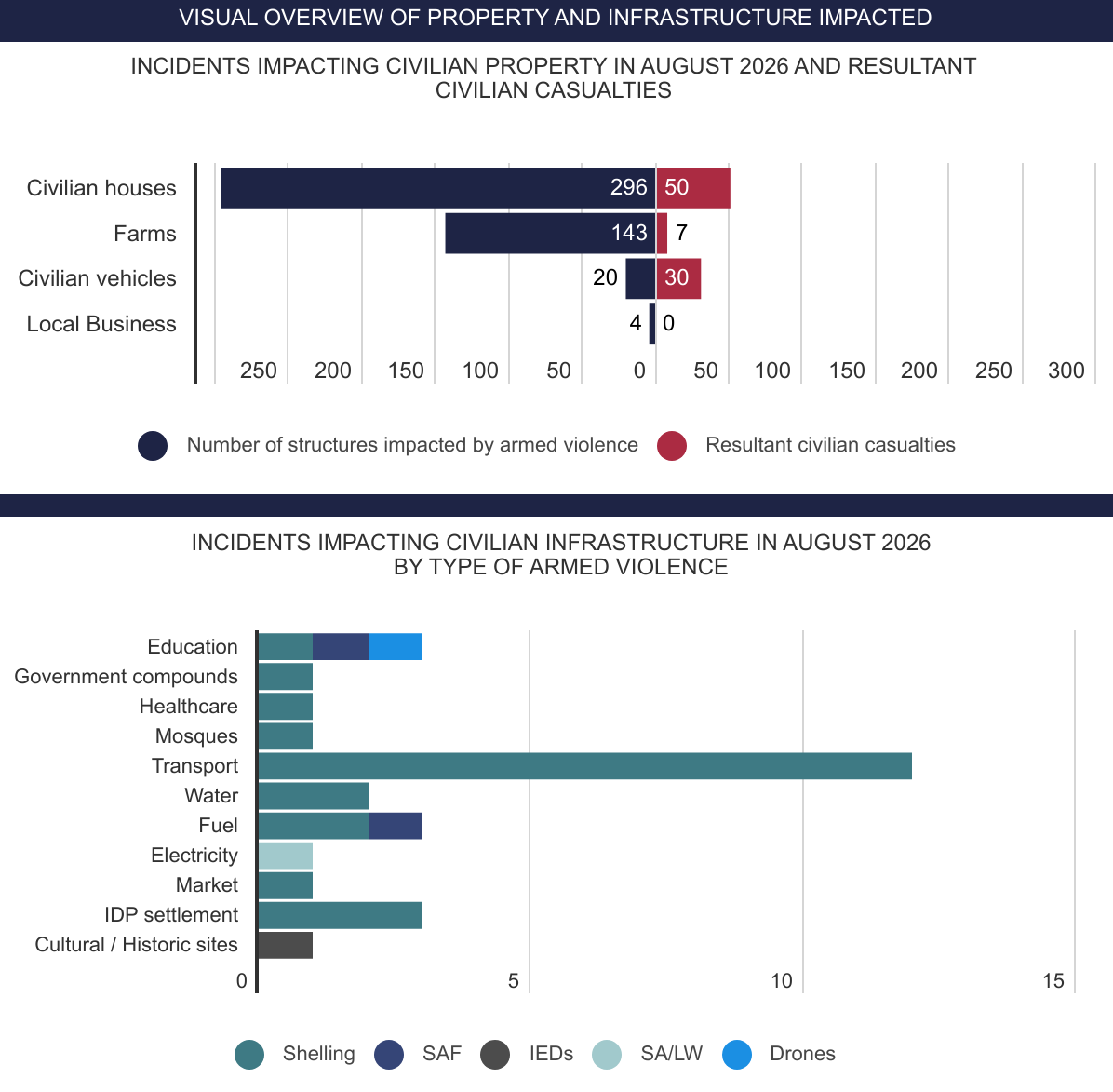
Increasing levels of violence along the frontlines led to the displacement of an estimated 426 families in August, with Taizz (157), Ad Dali (85), Sadah (70), and Al Hudaydah (68) seeing the greatest impact. This is the highest displacement rate in a month since January 2022, and 47% more than all of the previous seven months of 2026 combined (226). Moreover, an estimated 1,980 households experienced obstruction to flight or repeated displacement as a result of the hostilities impacting IDP camps this month, all in Marib, the most since October 2023.
Additionally, strikes against transport infrastructure, including the Al Mukha port, Dhubab air and sea port, and several main roads in Sadah, are estimated to have disrupted access to transport services for over 500,000 households countrywide. The repeated strikes against the Al Mukha port, in particular, have suspended operations and are assessed to have disrupted trade and supply chains across western Yemen.
|
|
|
|
|
|
|
|
|
|
|
|
|
|
|
The Civilian Impact Monitoring Project is a monitoring mechanism for the collection, analysis and dissemination of open source data on the civilian impact from armed violence in Yemen, in order to inform and complement protection programming.
|
|
|
|
|
|
|
Click here to subscribe to our flash, daily and weekly reporting,
or visit our website here.
For further information, please contact us at contact@civilianimpact.org.
|
|
|
|
|
|
|