|
|
|
|
This is the Civilian Impact Monitoring Project monthly visual and analytical report, providing an overview of all incidents of armed violence reported to have had a direct impact on civilians in Yemen in January 2026. The report covers civilian casualties, incident distribution, type of armed violence and impact upon civilian property and infrastructure.
|
|
|
NATIONWIDE SNAPSHOT: CIVILIAN IMPACT FROM INCIDENTS OF ARMED VIOLENCE
|
|
|
|
|
|
|
Civilian Impact Incidents
Civilian Casualties* (Fatalities / Injuries)
Child Casualties (Fatalities / Injuries)
Women Casualties (Fatalities / Injuries)
|
|
|
|
|
|
102
146 (39 / 107)
8 (8 / 0)
8 (5 / 3)
|
|
|
|
|
|
|
Compared to previous month
|
|
|
|
|
|
Compared to 2025 monthly average
|
|
|
|
|
|
|
|
|
*Please note, all information and numbers included in CIMP reporting are based on information publicly available in open sources, and have not been independently verified
|
|
|
|
|
|
|
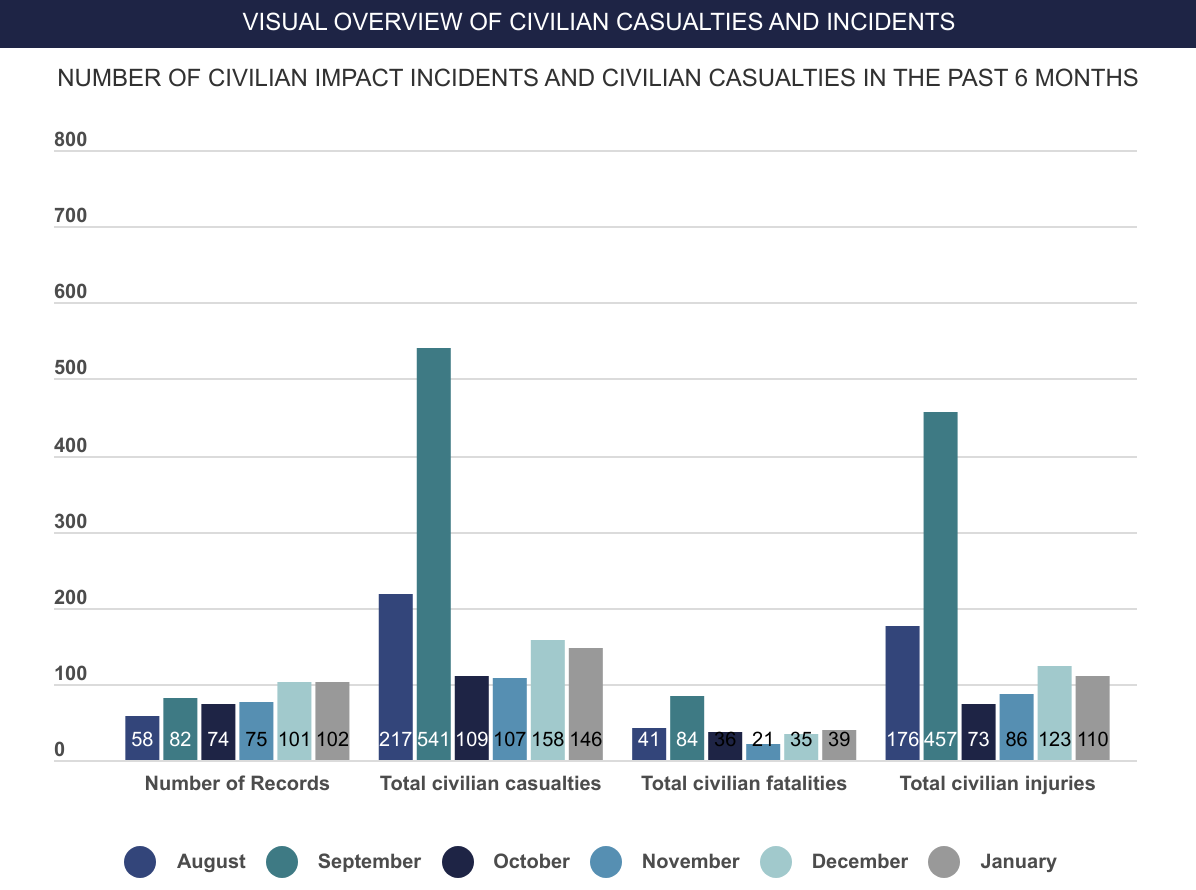
There was a slight decrease in civilian casualty numbers in January
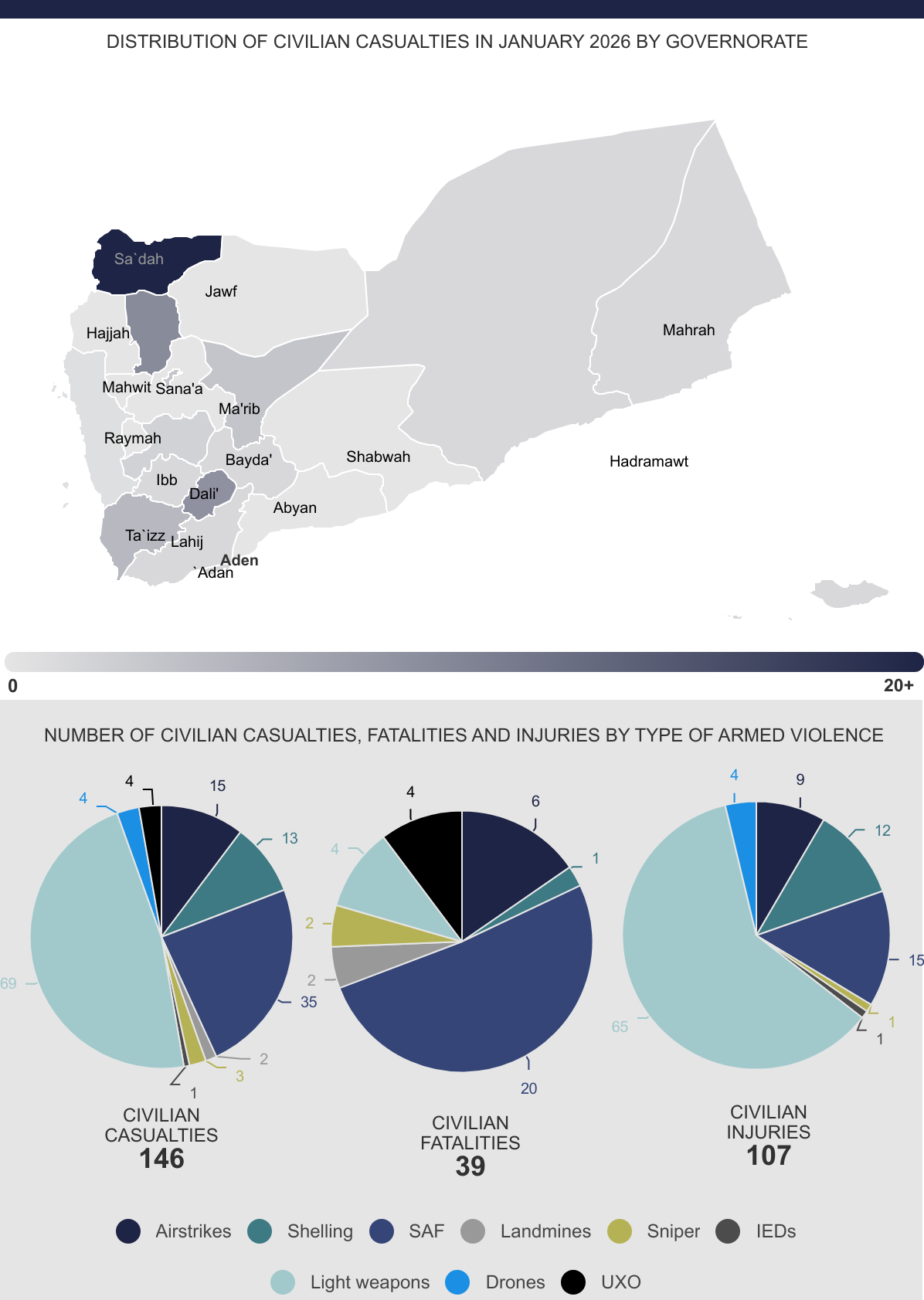
Compared to December (158), casualty numbers in January (146) dropped slightly, mainly because of a fall in frontline-related casualties in Sadah. Nonetheless, frontline violence was still the leading cause (62%) of all civilian casualties this month (90), despite January witnessing a wave of airstrikes following military and political escalations in the south of the country. Children and women casualties also comparatively fell, dropping by almost 50% (16) compared to the month prior (29), two-thirds (63%) of whom (10) were the result of shootings.
Isolated shootings and hand grenade explosions have been the main cause of casualties among children and women (36) over the past quarter (113) (October 37; November 37; December 39), resulting in around a third of all child and women victims (32%) during that period. In fact, of all the victims of violence in 2025 related to small arms fire (SAF) and hand grenade explosions (453), around a quarter (107; 24%) were children and women. In contrast, children and women victims from frontline violence (88) made up only a sixth (15%) of the casualty total (605).
It is expected that as long as there is easy access to weapons, a weakened rule of law, and an absence of accountability, civilians will continue to suffer from armed violence, especially children and women in densely populated areas, with urban centres like the cities of Ibb, Sanaa, and Taizz being the major locales for weapons use against vulnerable groups.
15 civilians were killed and injured following airstrikes in eastern Yemen and Ad Dali
The political and military escalations in Hadramawt and Al Mahrah during December slowed in January as counter-deployments took over Shabwah, Abyan, Lahij, and Aden. The campaign culminated early in the month when airstrikes targeted Ad Dali on 7 January, where military reinforcements purported to have been smuggled from Aden were hit near Ad Dali city. The strikes resulted in at least a dozen civilian casualties, with the latest estimates putting the number at 5 killed and 7 injured, when the bombings impacted houses near a military camp. The strikes marked the first time that fighter jets had hit Ad Dali since 2020.
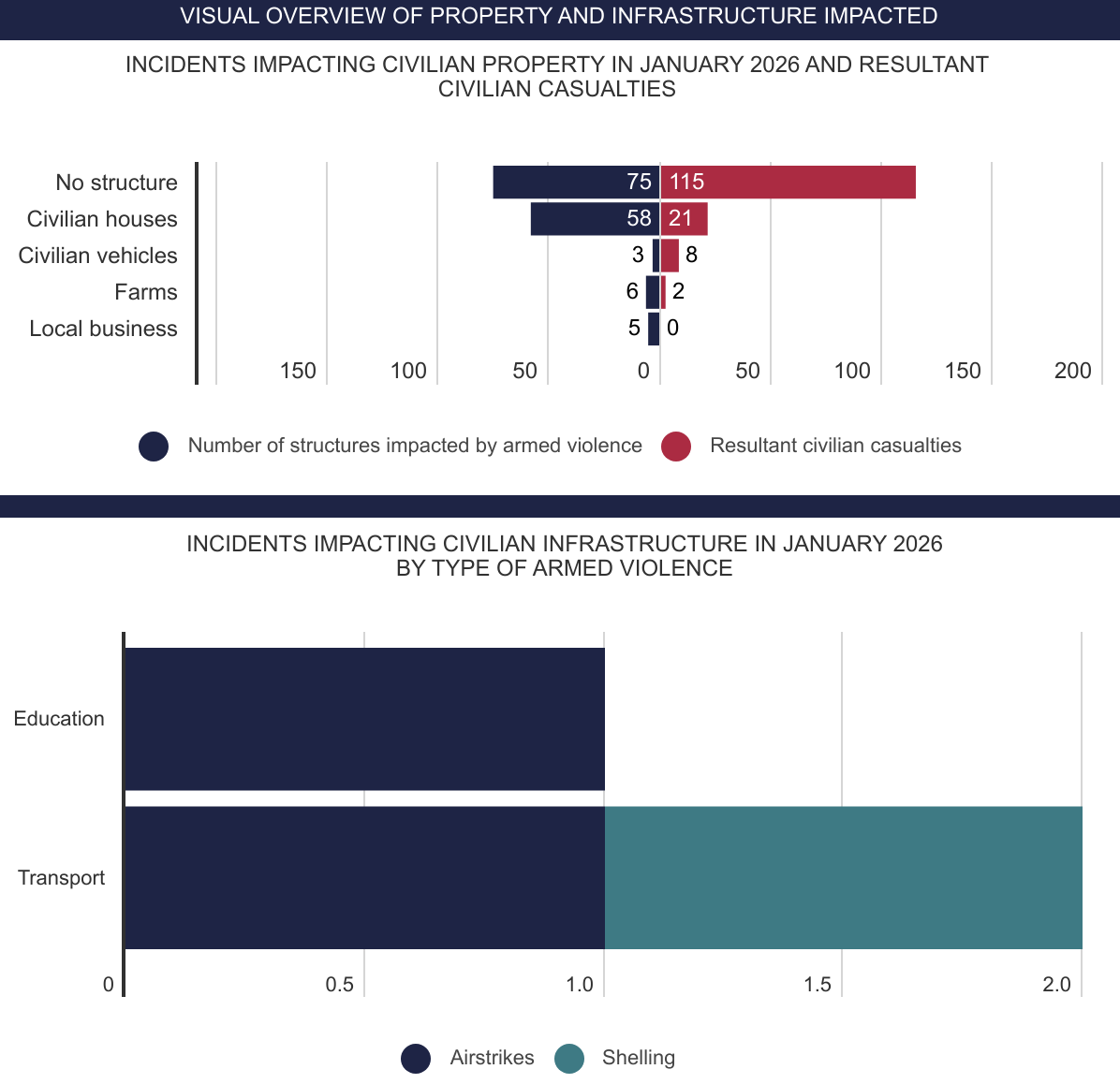
Another 3 civilians were among the airstrike casualties in Hadramawt and Al Mahrah. In the former, an aircraft hit a Light Tactical Vehicle (LTV) in Al Qatn district to the northwest of the governorate on 2 January, killing 1 civilian bystander, as well as impacting nearby houses and damaging a school. In Al Mahrah, 2 civilians were injured when strikes hit the headquarters of the Al Mahrah Military Axis to the northeast of Al Ghaydah city. The strikes followed several air raids just a few days earlier on 30 December that hit the Al Mukalla seaport on 30 December. The airstrikes marked the first time since the start of the conflict in 2015 that air raids had hit the eastern governorates of Hadramawt and Al Mahrah.
Frontlines in Sadah once again saw the most civilian victims of armed violence
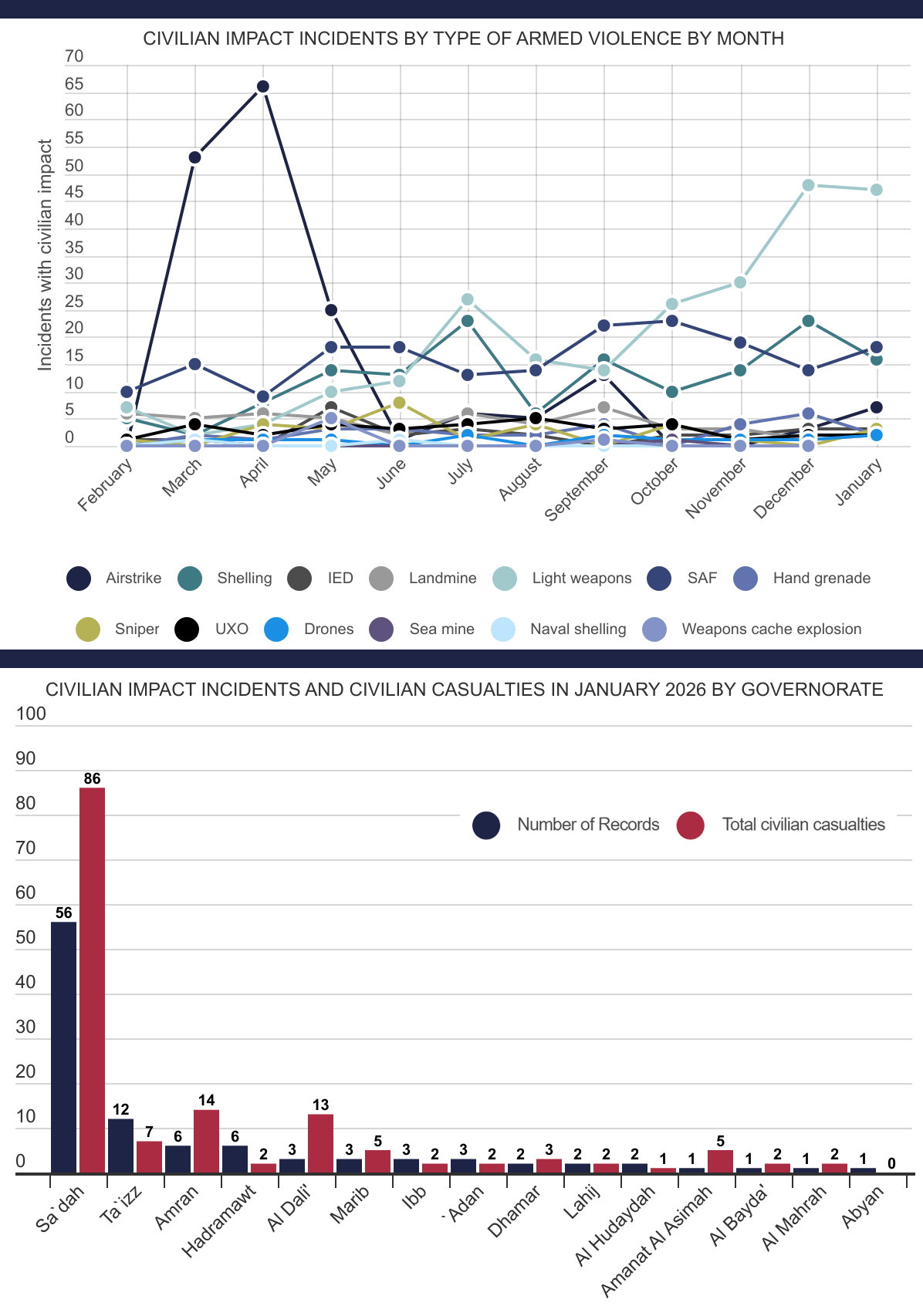
The drop-off in frontline violence in Sadah (85) was the main reason for the slight decline in overall casualties in January (89) compared to the month prior (104). Across the country, frontline casualties (89) fell by around 14% from December (104), with Sadah seeing a drop from 99 to 85. Nonetheless, the casualty numbers in the governorate remained the second-highest in the past 12 months, after December. Taizz (3) and Ad Dali (1) saw the remaining frontline casualties, while southern Al Hudaydah saw an incident of heavy fire impacting houses, marking the first time that frontline-related activity was reported in the governorate since November.
In Amran, tribal clashes related to vengeance issues led to the use of heavy artillery against houses in Harf Sufyan in the northwest of the governorate. The incident marked only the second time on CIMP records that artillery fire has been used against residential areas in Amran. CIMP recorded 13 incidents in 2025 involving the use of heavy and light weapons against civilians for reasons related to tribal vengeance, disputes, and personal grievances, resulting in 27 casualties, with half of that number (13) resulting from a single incident in Al Bayda in early January.
Isolated shootings continued to cause the second-highest casualty numbers countrywide
A total of 34 civilians were the victims of isolated shootings in January, a slight decrease from December (39), and the lowest SAF monthly toll since September (52). A third of that number (10) were children (4) and women (6). Three of the incidents, all in Sanaa city and Amran, resulted in at least 5 casualties, all the result of disputes. Overall, half of all the victims of SAF incidents in January (16) were related to disputes, while checkpoint violence, vengeance issues, or isolated shootings caused the remaining. Amran accounted for nearly half of the total SAF casualties (14) this month, marking the most civilian victims in the governorate in a single month (excluding airstrikes) since August (8). Amran has now seen 45 civilian deaths and injuries from shootings since January last year, making the governorate the third highest after Taizz (54) and Ibb (71).
IED explosion targeted a military official in Aden
7 civilians (6 fatalities; 1 injury) were impacted by Explosive Remnants of War (ERW) this month, the lowest count since June (8). However, there was a notable incident in Aden on 21 January: an IED blast targeted a high-ranking military official as his convoy was passing, injuring 1 civilian bystander and killing and wounding 8 soldiers. Nearby shops and houses were also damaged in the explosion in northern Aden on the border with Lahij. Rather than underscoring the threat that ERW continues to pose to civilian populations along previous frontlines, January brought a new dimension to the risk: the targeting of military and security officials inside crowded cities, especially in Aden. However, there have been no other such attempts since then, despite the security situation in the south of the country still being unstable.
Security situation in the south remains tense
After the eastward December military deployments to Hadramawt and Al Mahrah, and the quick counter-deployments that not only retook the two governorates but also expanded into Shabwah, Abyan, Lahij, and Aden, the military situation in the south has calmed, especially following the airstrikes in Ad Dali on 7 January. However, the security situation remains tense. Protests were reported in mid-January demanding that authorities reveal the whereabouts of forcibly disappeared detainees, while other demonstrations called for local reforms. Suspected VEO activity was also reported in Hadramawt, Marib, Shabwah, and Abyan, including anti-VEO drone strikes on a house in the east of Marib governorate, the second such strike in the past two months.
Despite the re-opening of airports in Ataq, Al Mukalla City, Al Ghayda, and Al Mukha, and with security improvements being instituted at Aden airport, there are still concerns that the longer-term instability in the south will persist as multiple political and military factions remain on the ground despite international attempts to unify the local political scene. These factions are expected to spoil efforts at external de-escalation and contribute to further volatility, manifesting in protests, IED explosions, and targeted assassinations.
Additionally, the military and security redeployments in the south have raised tensions more broadly across the country, though they have not yet led to renewed armed violence on the country’s largely dormant frontlines. Despite ongoing security concerns in the south, a dramatic shift along active frontlines is unlikely in the short term until the political situation is resolved. For the time being, the warring parties are more focused on addressing their pressing political and economic concerns than on launching new territorial advances that could risk undermining the 2022 truce.
|
|
|
|
|
|
|
|
|
|
|
|
|
|
|
The Civilian Impact Monitoring Project is a monitoring mechanism for the collection, analysis and dissemination of open source data on the civilian impact from armed violence in Yemen, in order to inform and complement protection programming.
|
|
|
|
|
|
|
Click here to subscribe to our flash, daily and weekly reporting,
or visit our website here.
For further information, please contact us at contact@civilianimpact.org.
|
|
|
|
|
|
|