|
|
|
|
This is the Civilian Impact Monitoring Project monthly visual and analytical report, providing an overview of all incidents of armed violence reported to have had a direct impact on civilians in Yemen in November 2025. The report covers civilian casualties, incident distribution, type of armed violence and impact upon civilian property and infrastructure.
|
|
|
NATIONWIDE SNAPSHOT: CIVILIAN IMPACT FROM INCIDENTS OF ARMED VIOLENCE
|
|
|
|
|
|
|
Civilian Impact Incidents
Civilian Casualties* (Fatalities / Injuries)
Child Casualties (Fatalities / Injuries)
Women Casualties (Fatalities / Injuries)
|
|
|
|
|
|
75
107 (21 / 86)
9 (3 / 6)
3 (3 / 0)
|
|
|
|
|
|
|
Compared to previous month
|
|
|
|
|
|
Compared to 2024 monthly average
|
|
|
|
|
|
|
|
|
*Please note, all information and numbers included in CIMP reporting are based on information publicly available in open sources, and have not been independently verified
|
|
|
|
|
|
|
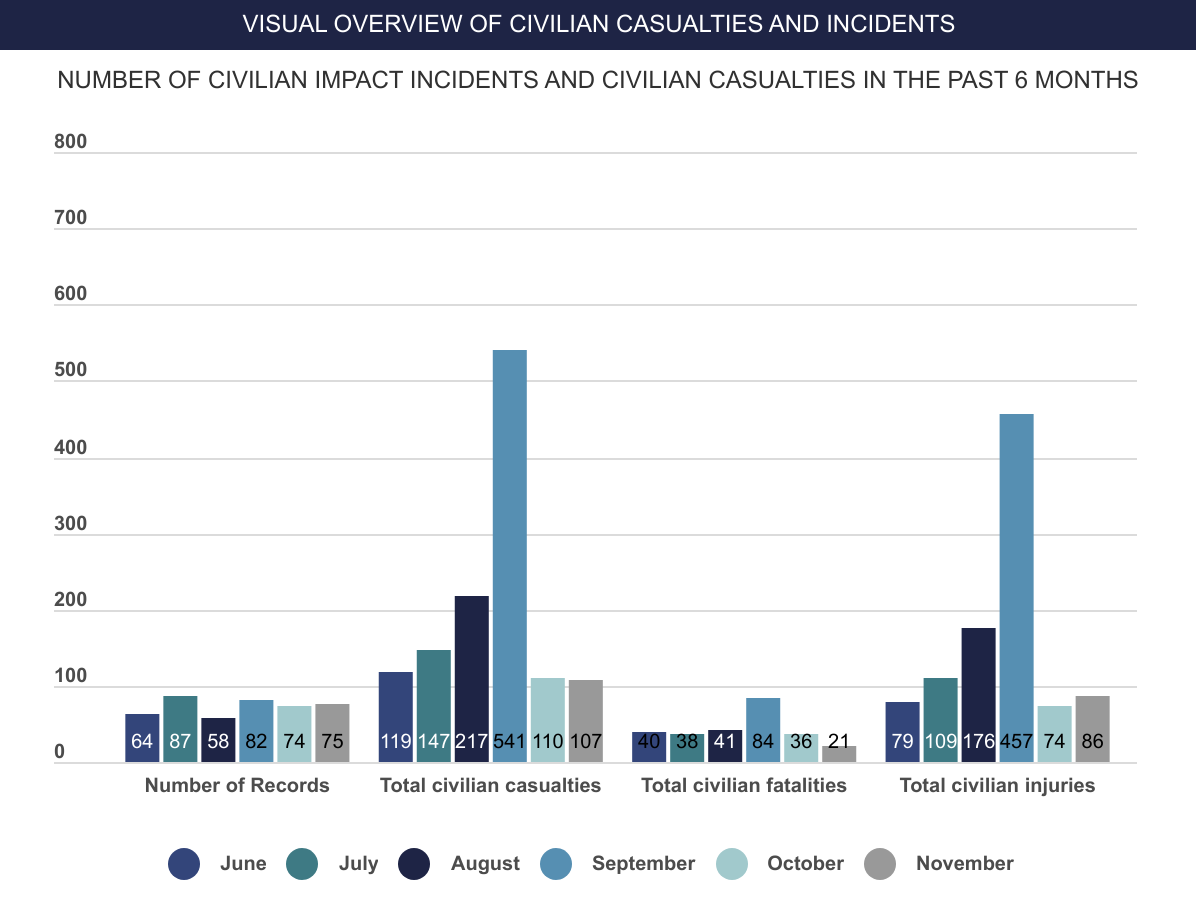
November’s incidents and casualty numbers fell slightly compared to October
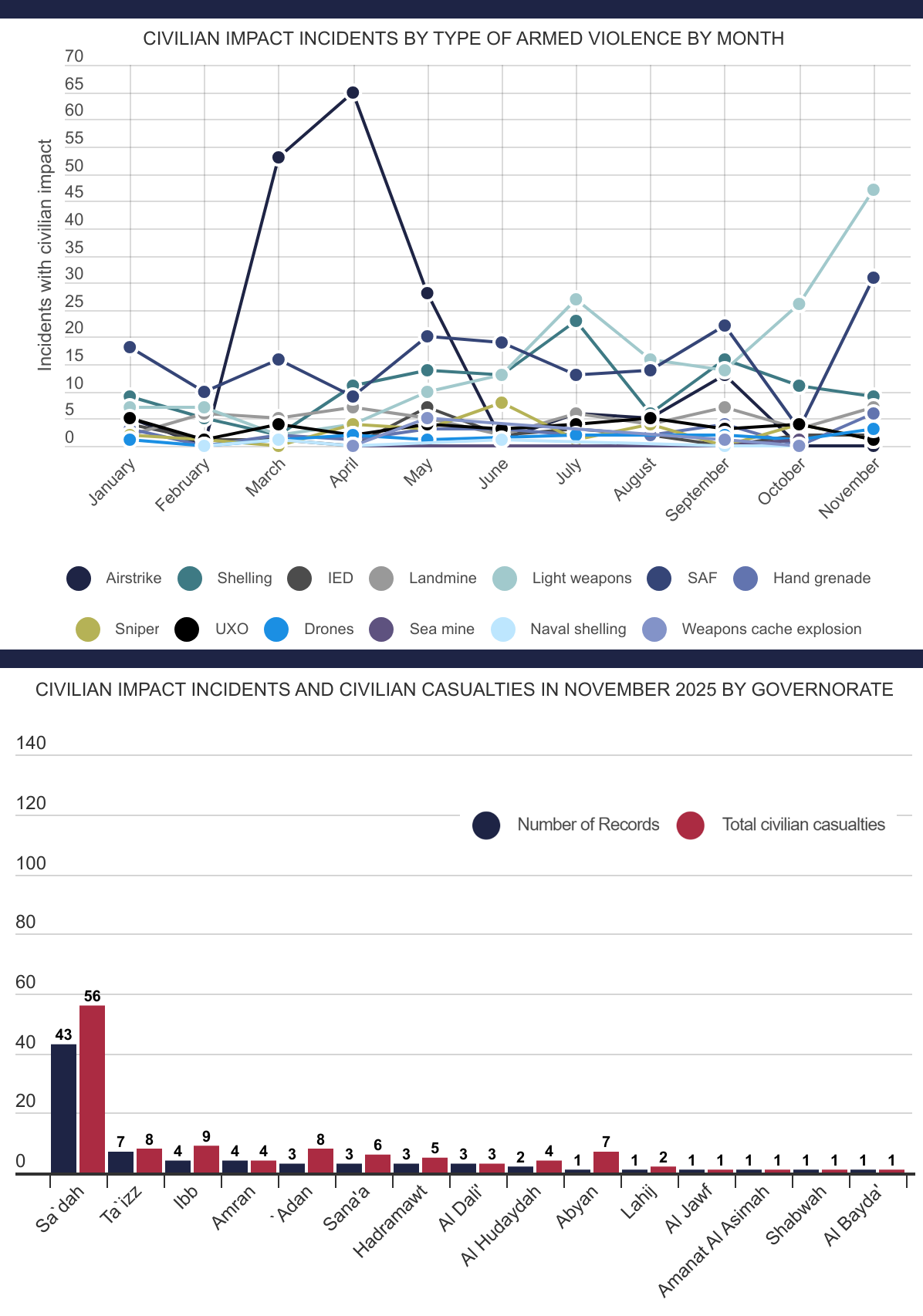
Civilian casualties dropped for the second consecutive month, falling slightly (107) compared to October (110), but by around 80% from September (541). November also marked the second month in a row that no airstrikes have been reported, making it only the third month this year, after February and October, that no airstrikes have hit any civilian objects or infrastructure. As a result, the month saw the second-lowest civilian casualty count in 2025, albeit around double the lowest count recorded this year (February: 57). Children and women casualties were also the second lowest this year (12) after February (11), having dropped by more than half compared to the month prior (27).
It is assessed that the fall in children and women casualties is related to a decrease in ERW incidents (3 in November compared to 5 children and women killed and injured by ERW in October), as well as a drop in frontline hostilities near residential areas in Ad Dali, Lahij, and Taizz (5 in November compared to 14 children and women in October), even though they increased Sadah, where frontline activity has mainly focused along the border and away from densely-populated centres. In total, 8 children and women were killed and injured as a result of both frontline hostilities and ERW in November, compared to 19 in October, the two governorates accounting for more than two-thirds of the countrywide monthly children and women casualties (70% in October; 67% in November).
Around half of the casualties in Sadah were migrants
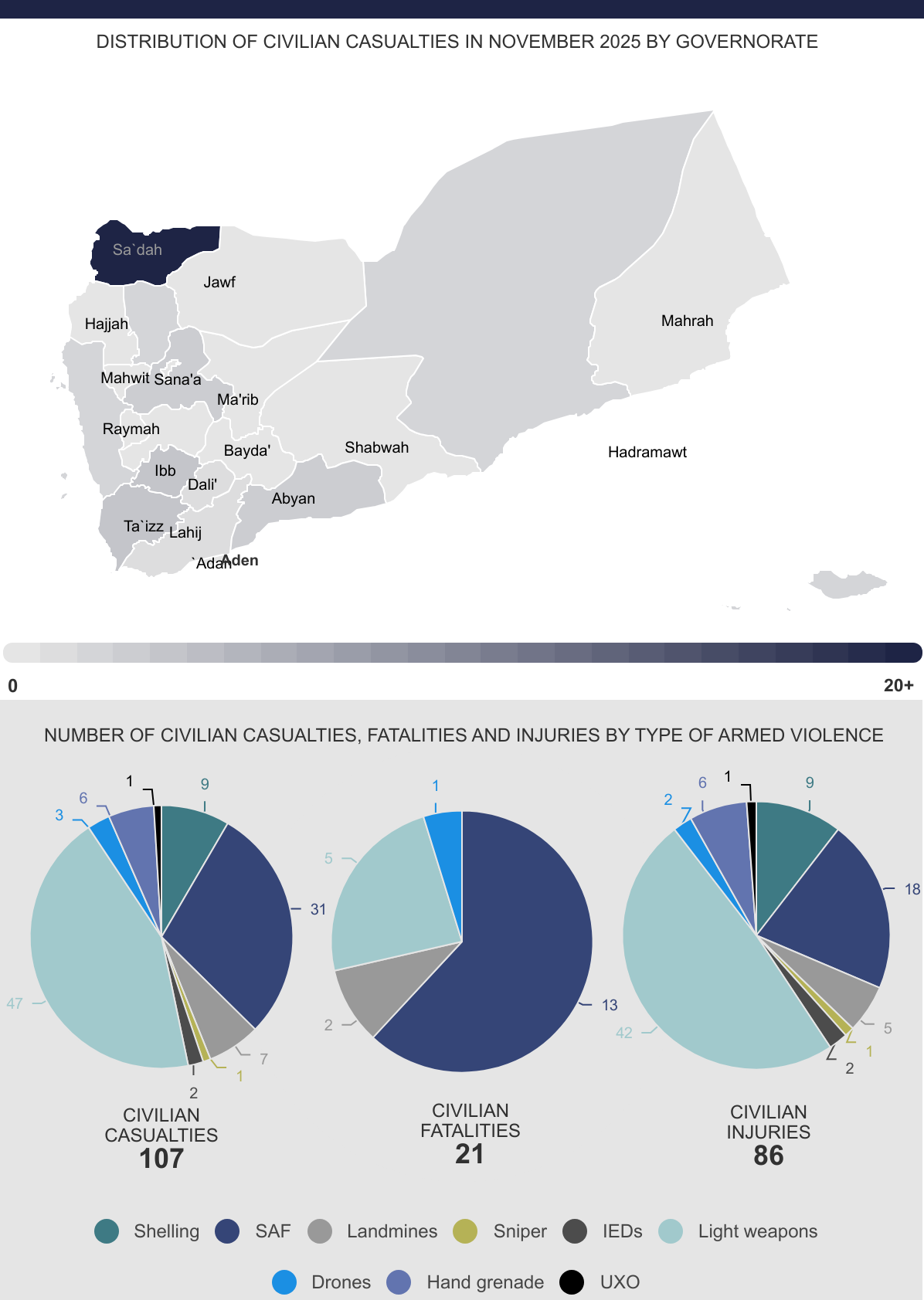
A total of 60 civilians were killed and injured along active frontlines, with more than 90% of those (55) having been reported in Sadah. Around half of the civilian victims in Sadah were migrants (29), marking the second-highest casualty toll among migrants countrywide this year after April, when airstrikes hit a detention centre, also in Sadah, causing 133 deaths and injuries in a single incident. It is assessed that the increase in casualty numbers in Sadah is related to a recent uptick in illegal attempts to cross the northern border, especially among migrant populations in the areas impacted. The casualties in Sadah this month were also the highest since July (65), around 15% higher than in October (46). All the casualties in Sadah were recorded in the governorate’s northern and northwestern districts, with Monabbih district witnessing the highest number of victims (30).
Al Hudaydah saw the first civilian casualties caused by frontline hostilities since May; the incident was caused by drone strikes hitting residential areas to the southeast of the governorate on the border with Taizz. Additionally, frontline violence was reported in Taizz and Shabwah, with the latter witnessing the first incident of frontline fighting in 5 months. However, in Taizz, only 2 civilian casualties were reported, the lowest since March.
Elsewhere, there were widespread military mobilisations in Ad Dali, Taizz, the southern outskirts of Marib City, western Shabwah on the border with Al Bayda, and the east of Al Jawf, but the impact on civilians has been minimal. This is partly explained by the warring parties’ increased focus on reinforcing their existing positions rather than territorial expansion, and by a reluctance to engage in more forceful action that could lead to a breakdown of the countrywide truce that has held since 2022.
Isolated incidents caused the second-highest number of deaths and injuries
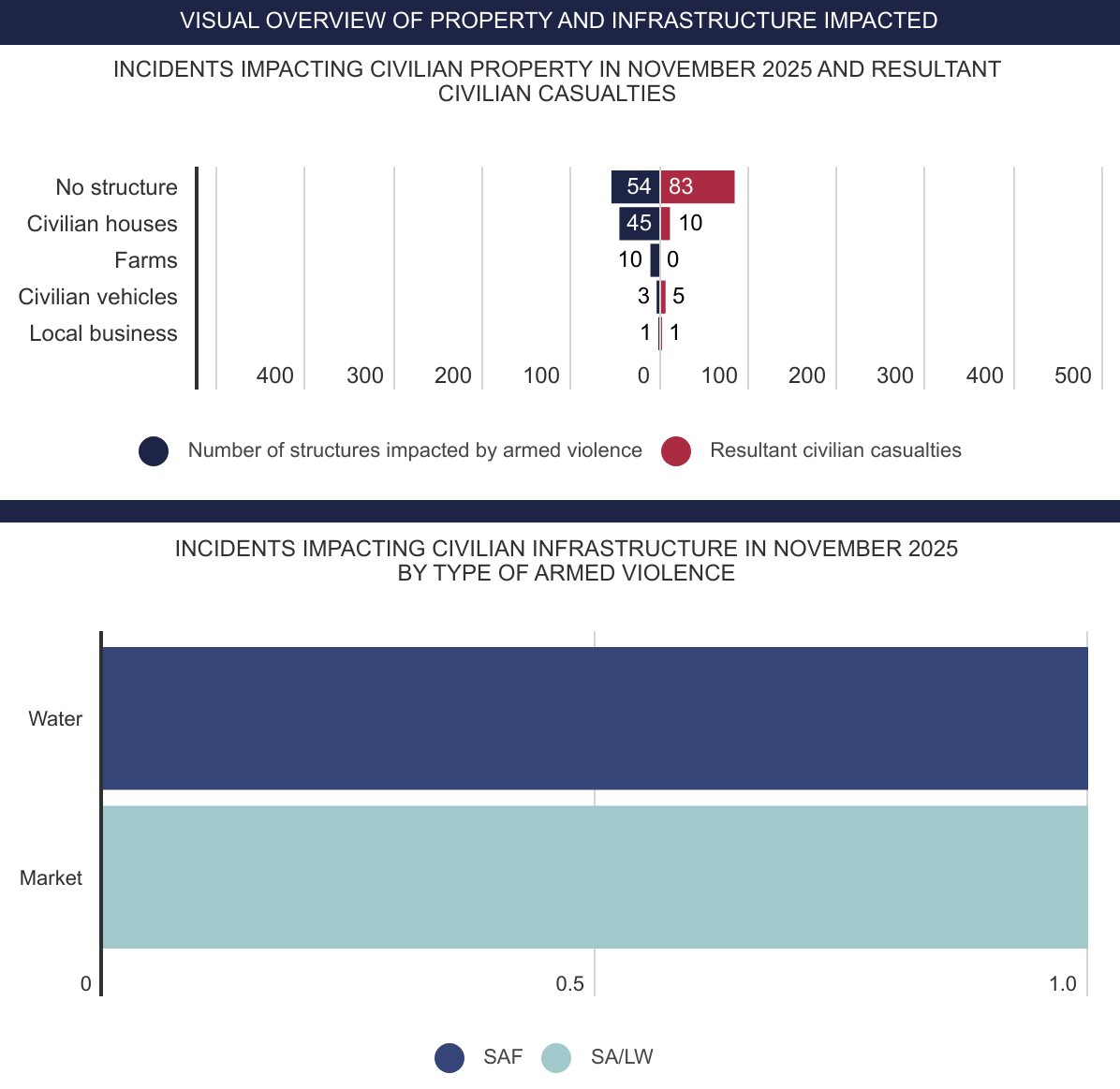
Civilian victims from isolated shootings unrelated to the overall conflict fell by around 15% in November (31) compared to the month before (37). Abyan saw the highest number of casualties, primarily during a shooting at a local market that wounded 7 civilian bystanders. The second-highest casualty rate was reported in Hadramawt (5), followed by Amran (4) and Ibb (4). Additionally, a dispute in Ibb damaged a water pump, restricting access to water for an estimated 2,000 households in the centre of the governorate. A similar incident was reported in Amran in October, resulting in restricted access to water services.
Hand grenade incidents added to the number of casualties from isolated incidents, with 6 civilians injured. 5 of those were reported in 1 incident following a dispute inside a house in Ibb, while the remaining casualty was recorded in Ad Dali. Hand grenade explosions have now caused 63 casualties so far this year, with the number in November down by 50% compared to September (11), while no incidents were reported in October. Of the hand grenade casualties this year, 25 (40%) have been caused by disputes, indicating easy access to weapons, as well as a heightened tendency to resort to violence to settle minor disputes.
ERW incidents led to a further 10 casualties
November also marked the second-lowest ERW casualty count (10) this year, after June (8). Casualties dropped by a third compared to October (15) and by around two-thirds (58%) in relation to September (24). A total of 185 civilians have been killed and injured by landmines, IEDs, Unexploded Ordnance (UXO), and sea mines so far in 2025, around a third (30%) lower than the same period in 2024 (263). ERW incidents this year have greatly varied week-to-week and month-to-month, with the highest number of deaths and injuries in a single month being September. As such, it is expected that casualty rates will remain low through the end of the year, unless a high-casualty incident occurs in December, raising casualty numbers above the monthly average (17) for 2025.
Security campaigns led to restricted freedom of movement
In Al Bayda, tribal vengeance issues in Rada resulted in some 44 deaths and injuries in mid-November, all among tribal combatants, while houses and farms sustained damage in the fighting. The incident was unrelated to frontline violence or a security campaign in the area, but displacement and loss of livelihood likely resulted from the hostilities.
There were, though, two security campaigns during the month in Taizz: in Al Waziiyah district to the southwest of the governorate and in Ash Shamayatayn on the southern border with Lahij. The campaign in Al Waziiyah followed the interception of a vehicle belonging to a humanitarian agency in the district, during which some of its belongings were confiscated. In Ash Shamayatayn, clashes left at least 7 security personnel associated with local government officials dead and wounded, prompting a security campaign to be deployed to the area. Neither campaign resulted in civilian casualties, but the incident in southern Taizz restricted the flow of civilian traffic to Aden.
Power outages persisted in the south; fuel last entered Al Hudaydah port in 2024
Power failure in the south of the country persisted. The leading cause of the continued outages has been roadblocks in Marib and Abyan, which have constrained the flow of fuel to Aden. The governorates of Abyan and Lahij have also reportedly gone without power for nearly 2 months. Another reason for the blackouts has been the government’s termination of contracts with diesel-fired power providers earlier this year, which led to a decrease in imported fuel. Nonetheless, there have been no protests demanding improvements in basic services, nor have there been any signs that people would take to the streets to express their anger about the issue.
However, by the end of the month, political tensions spiked in Hadramawt when armed factions took control of the PetroMasila oil facilities. As a result, fuel production ceased, leading to electricity disruptions in major cities across the governorate. Fuel supplies to Aden, Abyan, and Lahij also stopped, exacerbating fuel shortages in the southern towns. Limited clashes later broke out between the armed sides in Sayun city and central Hadramawt, with casualties reported on both sides, but there were no reports of civilians being caught up in the clashes. The fighting has since stopped, but tensions remain in the eastern governorate.
|
|
|
|
|
|
|
|
|
|
|
|
|
|
|
The Civilian Impact Monitoring Project is a monitoring mechanism for the collection, analysis and dissemination of open source data on the civilian impact from armed violence in Yemen, in order to inform and complement protection programming.
|
|
|
|
|
|
|
Click here to subscribe to our flash, daily and weekly reporting,
or visit our website here.
For further information, please contact us at contact@civilianimpact.org.
|
|
|
|
|
|
|