|
|
|
|
This is the Civilian Impact Monitoring Project's monthly visual and analytical report, providing an overview of all incidents of armed violence reported to have directly impacted civilians in Yemen in April 2026. The report covers civilian casualties, incident distribution, types of armed violence, and impacts on civilian property and infrastructure.
|
|
|
NATIONWIDE SNAPSHOT: CIVILIAN IMPACT FROM INCIDENTS OF ARMED VIOLENCE
|
|
|
|
|
|
|
Civilian Impact Incidents
Civilian Casualties* (Fatalities / Injuries)
Child Casualties (Fatalities / Injuries)
Women Casualties (Fatalities / Injuries)
|
|
|
|
|
|
49
97 (26 / 71)
17 (6 / 11)
4 (1 / 3)
|
|
|
|
|
|
|
Compared to previous month
|
|
|
|
|
|
Compared to 2026 monthly average
|
|
|
|
|
|
|
|
|
*Please note, all information and numbers included in CIMP reporting are based on information publicly available in open sources, and have not been independently verified
|
|
|
|
|
|
|
Civilian deaths and injuries fell by a third compared to March
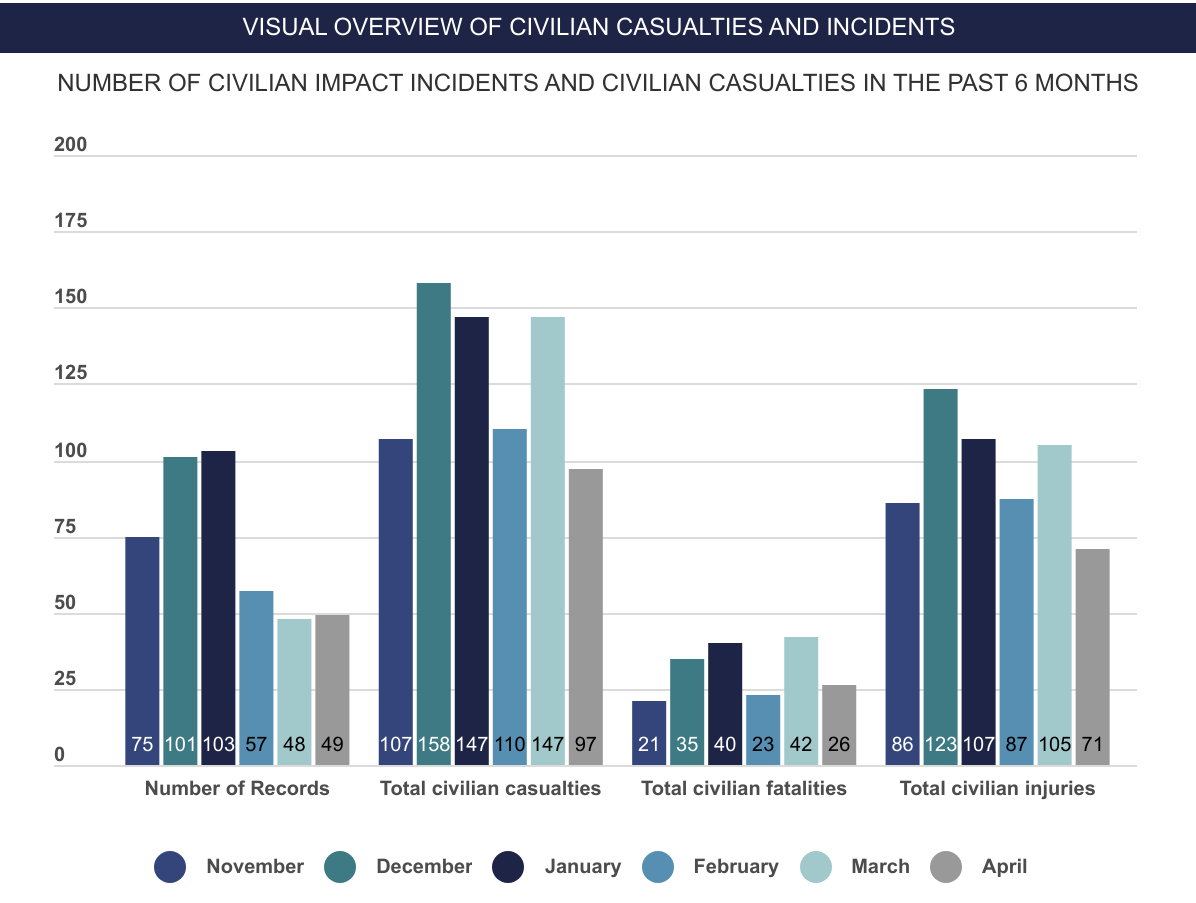
April accounted for the lowest monthly casualty count so far this year (97), and the fewest in a single month since February 2025 (57). Compared to March (147), the number of dead and wounded fell by over a third (34%). The main reason for the drop in the month’s casualty numbers has been a fall in frontline hostilities impacting civilians, which had been on a consistent downward trend over the previous four months, but accelerated in April (23) relative to March (76), falling by over two-thirds (68%) month-on-month. Casualties among children and women also decreased by 50% (21) from March (43), partly due to the broader drop along active frontlines, in addition to fewer children and women being the victims of isolated shooting incidents.
The month also marked a pause in regional hostilities, which ended on 8 April, with no reports of airstrikes in Yemen. However, tensions in the region remain high, and Yemen’s involvement in any upcoming re-escalation remains possible. Although there were no air raids on the country, despite renewed drone and missile launches, retaliatory airstrikes in the north of the country are still a risk, especially if strikes from Yemen hit sensitive targets in the region.
Casualties along active frontlines dropped again after a temporary spike in March
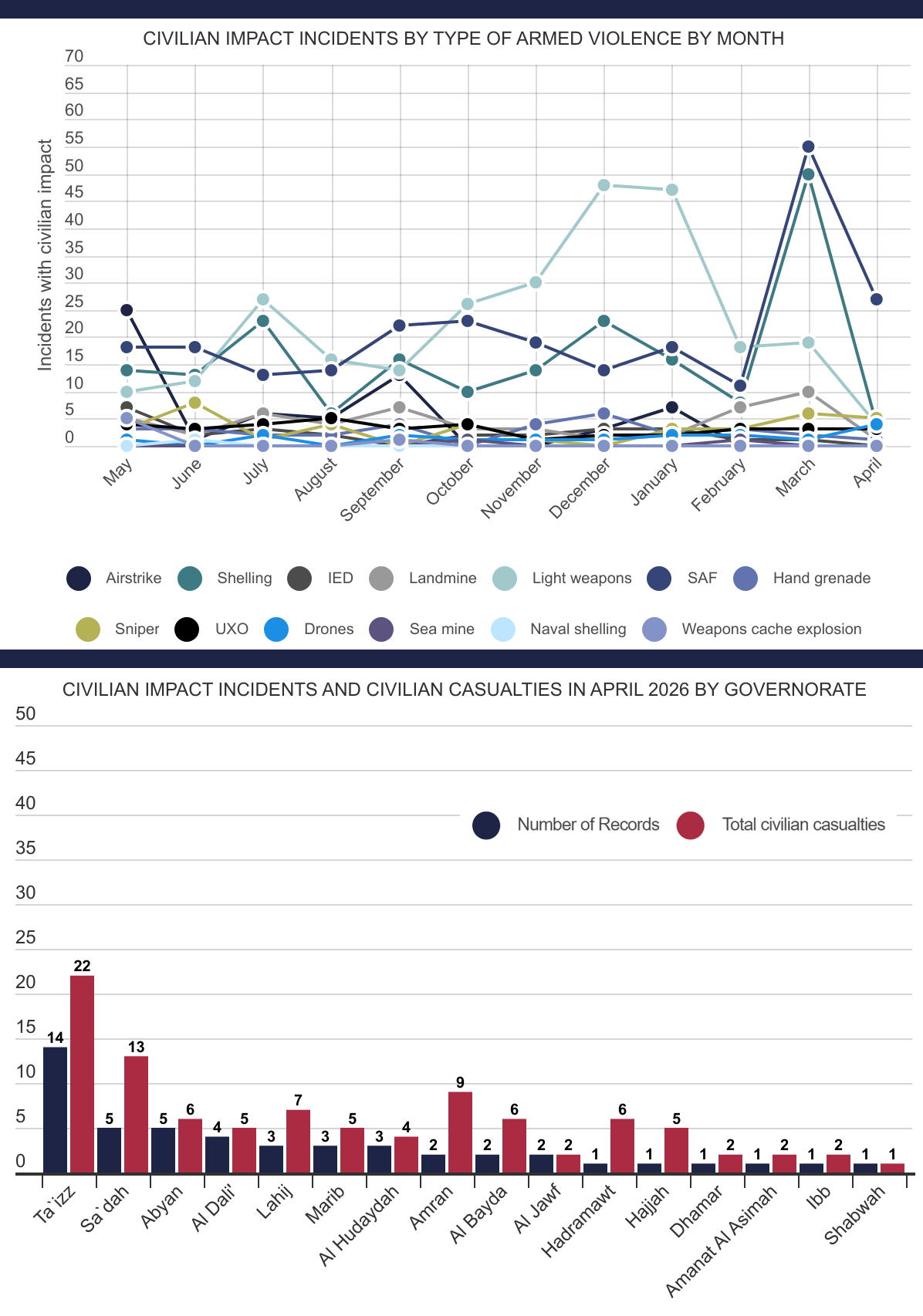
Frontline hostilities saw civilian casualty numbers fall again in April (23) following a temporary spike in March (76). Deaths and injuries along active frontlines had been trending downwards since December, making the increase in March appear to be an outlier rather than signalling a potential resurgence in hostilities. The main driver of the recent drop has been a decrease in casualties in the northern district of Sadah, where numbers fell by more than 50% this month (13) compared to March (30) and by around 85% compared to January (85). Meanwhile, in Taizz, frontline casualties nearly tripled (11) relative to the previous month (4), marking the highest number of civilians impacted by hostilities in the governorate since July of last year.
Despite declining monthly totals, the number of civilian casualties reported in the first four months of 2026 (237) due to frontline fighting is three times that of the same period last year (78). Sadah alone accounted for nearly half (42%) of that number (167), with casualties increasing fourfold compared to last year (40), while casualties in Taizz have risen by nearly 80% (25) relative to 2025 (14). As such, the decrease in casualty numbers could be temporary and related to the broader regional de-escalation, and it is possible that frontline fighting may resume in the coming weeks. However, any increase is likely to be gradual, unless there is a sudden shift in existing frontlines or in response to mass-casualty events.
Shootings caused two-thirds of the month’s dead and wounded
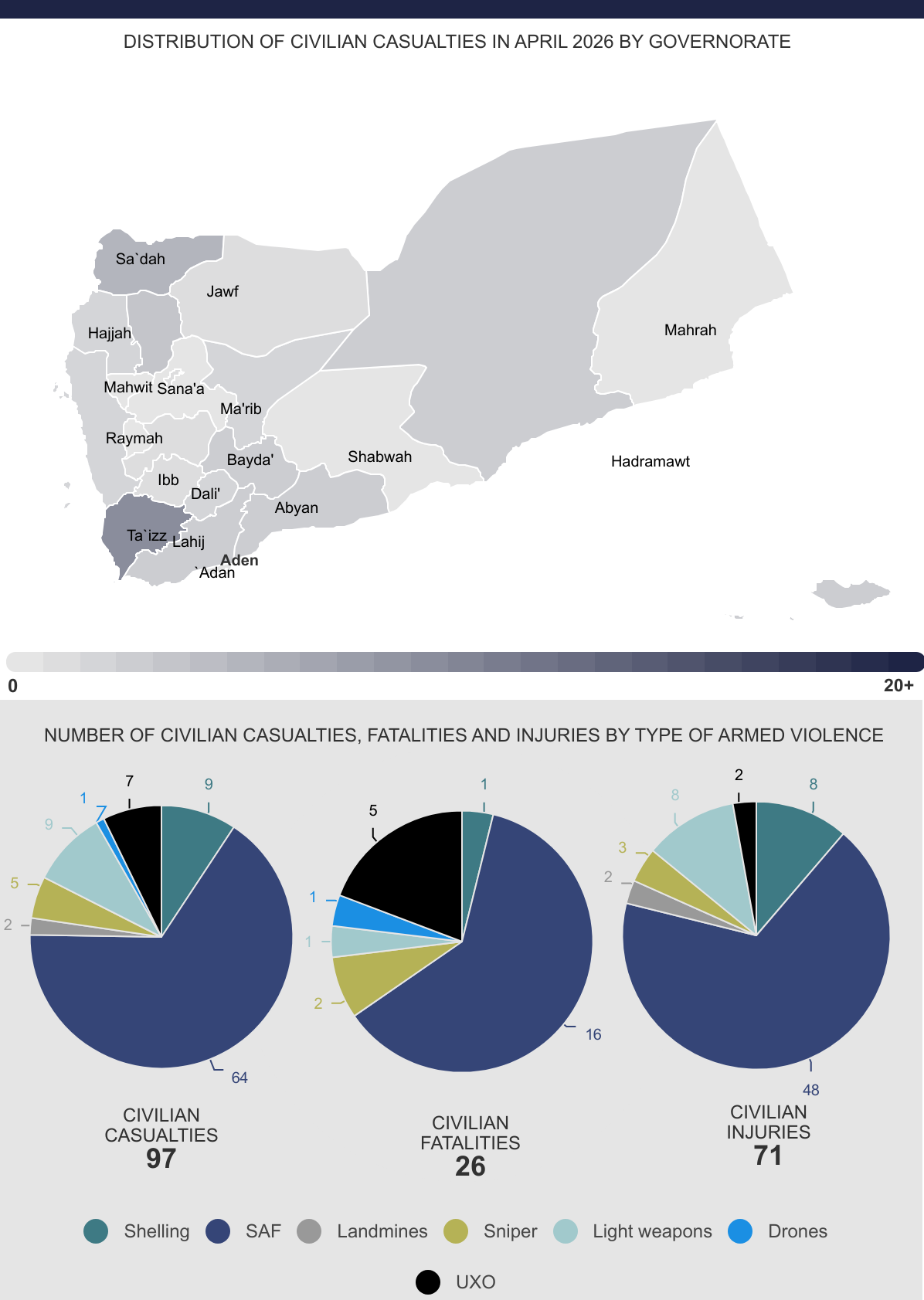
The majority of April’s civilian casualties (65) were caused by shootings, making up two-thirds of the month’s total tally. This is the highest number of casualties from shooting incidents so far this year, and the most since June 2025. It is also the first time in 2026 that isolated shootings resulted in more civilian victims than frontline violence. Taizz saw the highest number of civilian deaths and injuries from shootings (11), followed by Amran (9), and Lahij (7), while Abyan, Al Bayda, and Hadramawt accounted for 6 casualties each. A third (36%) of those shot (23) were victims of dispute-related issues, while around a quarter (23%) of the casualties (15) were caught up in crossfire or impacted by shrapnel from small arms fire.
So far this year, shooting and hand grenade incidents unrelated to the overall conflict have caused 193 civilian casualties, 33% higher than over the same four months at the start of 2025 (130). Taizz has seen the highest number this year (32), followed by Amran (31) and Hadramawt (21). The totals for the first four months of the year are already double the casualties recorded in the same period last year in Taizz (14) and a third higher in Hadramawt (14). The only difference among the top three governorates in terms of casualties has been Ibb, which saw casualties fall by two-thirds from 29 in 2025 to 10 in 2026.
ERW incidents dropped again after a temporary increase last month
Incidents involving Unexploded Ordnance (UXO) and landmines saw casualty numbers in April (9) fall by 36% compared to March, which is also a third lower than the monthly average for this year (14). Hajjah saw the most casualties, primarily due to a UXO explosion inside a house that led to the deaths and injuries of 4 children and 1 woman. 3 more casualties were reported in Al Hudaydah, and 1 in Ad Dali. The incident in Hajjah resulted in the second-highest number of children and women victims in a single ERW incident this year. Nonetheless, the overall number was lower than the monthly average for children and women ERW casualties in 2026 (6).
Al Hudaydah has so far topped the list for Explosive Remnants of Warfare (ERW) victims this year (33), accounting for 40% of the total recorded countrywide (56). This is almost double the rate the governorate saw during the first four months of 2025 (18). ERW incidents in recent months have been highly sporadic, following a random and unpredictable trend rather than a geographical or conflict-centric pattern. This was likely partly due to successful demining operations and the opening of main roads in Ad Dali and Taizz, which have reduced the number of civilians travelling through ERW-contaminated terrain. However, UXO is still a persistent threat, especially to children, who often mistake military ordnance for toys or reusable material, leading to deadly outcomes.
Protest-related violence and political tensions resulted in several civilian casualties
Protest-related violence and politically driven hostilities in April resulted in several civilian deaths and injuries. In Hadramawt, protest-related violence was responsible for 6 civilians being shot, all in a single incident, when crowds took to the streets as part of political rallies in the governorate. The Hadramawt shooting incident is the most civilian casualties caused by protest-related violence since September 2021. It is also the first incident of violence against protesters this year, and the first time that political demonstrators have been shot in the governorate since July 2023.
In Taizz, a security campaign in Al Waziiyah district, to the southwest of the governorate, resulted in 3 civilian casualties and heightened political tensions in the area. The campaign started after local armed groups exchanged fire with security personnel at a checkpoint on 2 April, wounding 2 female bystanders, while also killing and injuring several combatants on both sides. Following the shooting, local security forces launched intensive efforts to arrest those involved, including carrying out drone strikes on a house that killed at least 1 civilian. Political tensions in the area persisted until the end of the month, when mediation calmed the situation.
Political violence also led to another civilian casualty in Ad Dali city, when the local authority building came under fire. And, in Aden, a political figure was shot dead in an incident assessed to be part of political tensions in the city rather than an isolated shooting. The incidents came as authorities continued efforts to restructure security and political forces across the south of the country, to which factions aligned with recently disbanded southern political movements have repeatedly voiced strong opposition. The coming period is likely to continue to witness protests and political rallies across the south. Still, the likelihood of widespread protest-related violence is assessed to be relatively low, unless protesters disobey orders on public assembly or soldiers feel threatened by heightened political rhetoric.
|
|
|
|
|
|
|
|
|
|
|
|
|
|
|
The Civilian Impact Monitoring Project is a monitoring mechanism for the collection, analysis and dissemination of open source data on the civilian impact from armed violence in Yemen, in order to inform and complement protection programming.
|
|
|
|
|
|
|
Click here to subscribe to our flash, daily and weekly reporting,
or visit our website here.
For further information, please contact us at contact@civilianimpact.org.
|
|
|
|
|
|
|