|
|
|
|
This is the Civilian Impact Monitoring Project's monthly visual and analytical report, providing an overview of all incidents of armed violence reported to have directly impacted civilians in Yemen in May 2026. The report covers civilian casualties, incident distribution, types of armed violence, and impacts on civilian property and infrastructure.
|
|
|
NATIONWIDE SNAPSHOT: CIVILIAN IMPACT FROM INCIDENTS OF ARMED VIOLENCE
|
|
|
|
|
|
|
Civilian Impact Incidents
Civilian Casualties* (Fatalities / Injuries)
Child Casualties (Fatalities / Injuries)
Women Casualties (Fatalities / Injuries)
|
|
|
|
|
|
59
108 (35 / 73)
18 (7 / 11)
3 (0 / 3)
|
|
|
|
|
|
|
Compared to previous month
|
|
|
|
|
|
Compared to 2026 monthly average
|
|
|
|
|
|
|
|
|
*Please note, all information and numbers included in CIMP reporting are based on information publicly available in open sources, and have not been independently verified
|
|
|
|
|
|
|
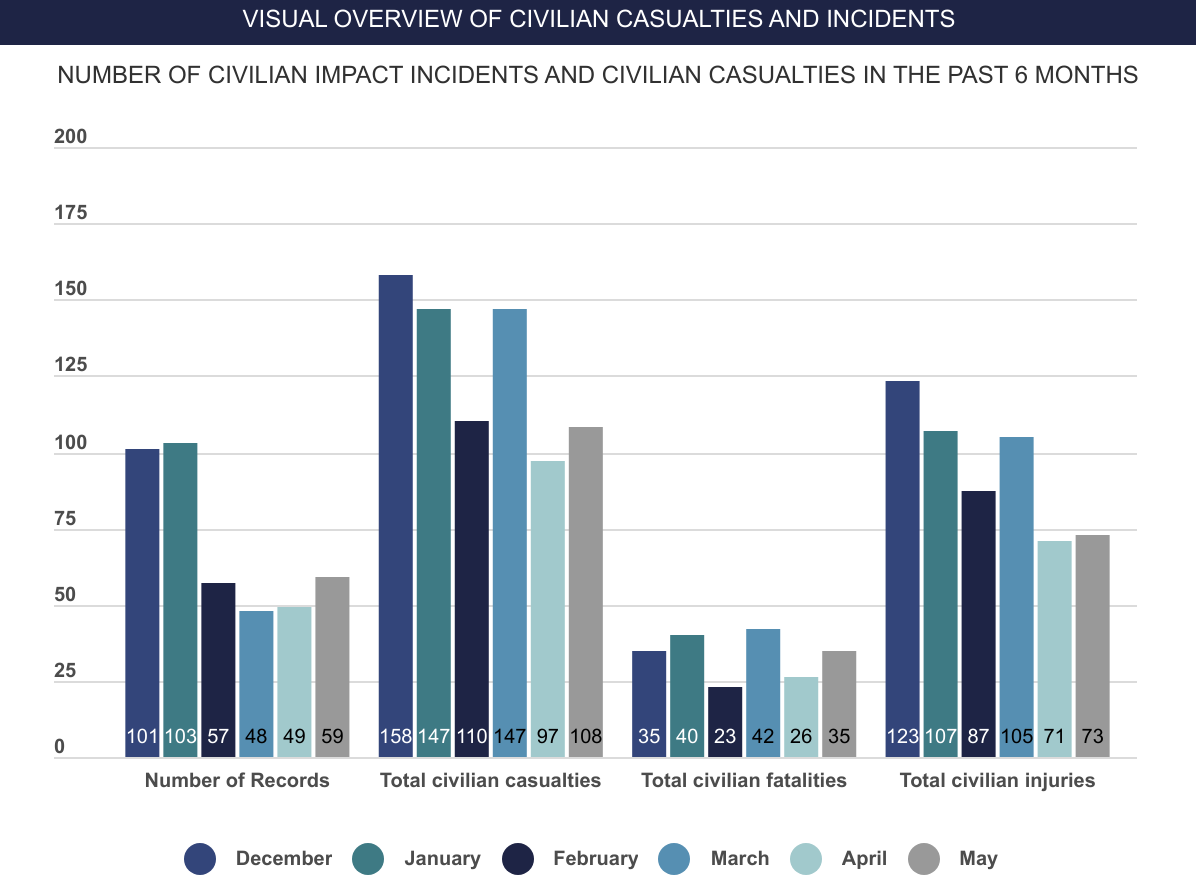
Deaths and injuries increased in May, but remained below the monthly average for 2026
The total casualty toll in May (108) increased slightly relative to the previous month (97), with the increase mainly driven by frontline hostilities in Sadah surging again after months of cumulative decline. However, other frontlines across the country calmed, especially the outskirts of Taizz city, where casualties fell significantly during the month. Despite the increase in May’s deaths and injuries, the total was still lower than the monthly average for this year (122), with the 2026 casualty numbers reaching 609, a tally almost 50% lower than during the same period last year (1,255). Children and women casualties (21) also fell below the 2026 monthly average (25), but were identical to the number reported in April (21), with child casualties (18) six-fold that of women (3) during the reporting period.
Meanwhile, in the wider region, hostilities remained contained and limited, although the blockade of the Strait of Hormuz continued. The threat to block the Bab Al Mandab Strait remained a real risk throughout the month, but no such action was taken, nor were missiles or drones launched from Yemen. As such, while airstrikes on northern Yemen have been a distinct possibility since the involvement of the country in the regional conflict in late March, no air raids have been reported since then. However, the likelihood of retaliatory airstrikes will persist as long as hostilities in the region continue, carrying a high risk of causing civilian casualties.
Frontlines in northern Sadah flared once again, while dropping significantly in Taizz
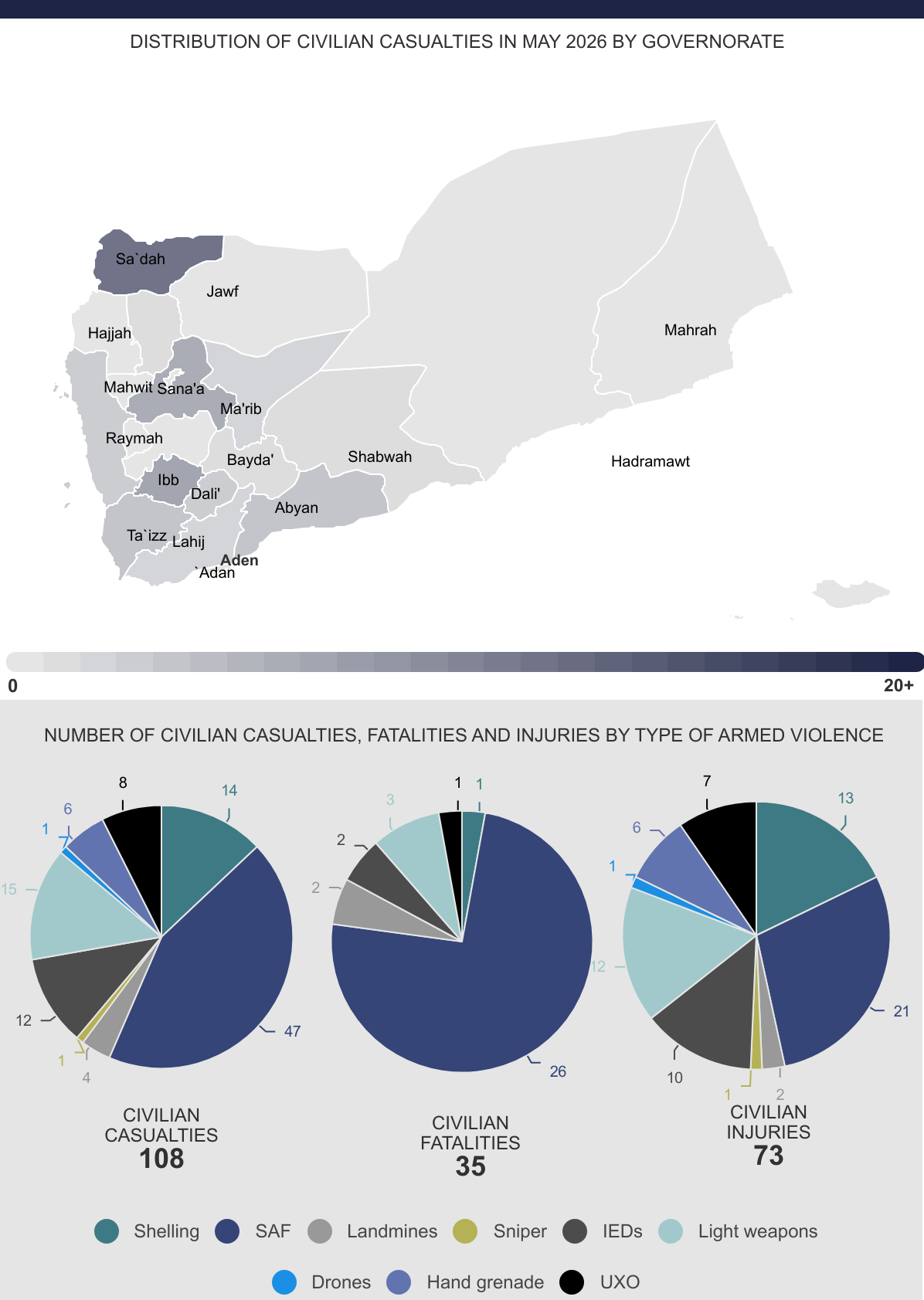
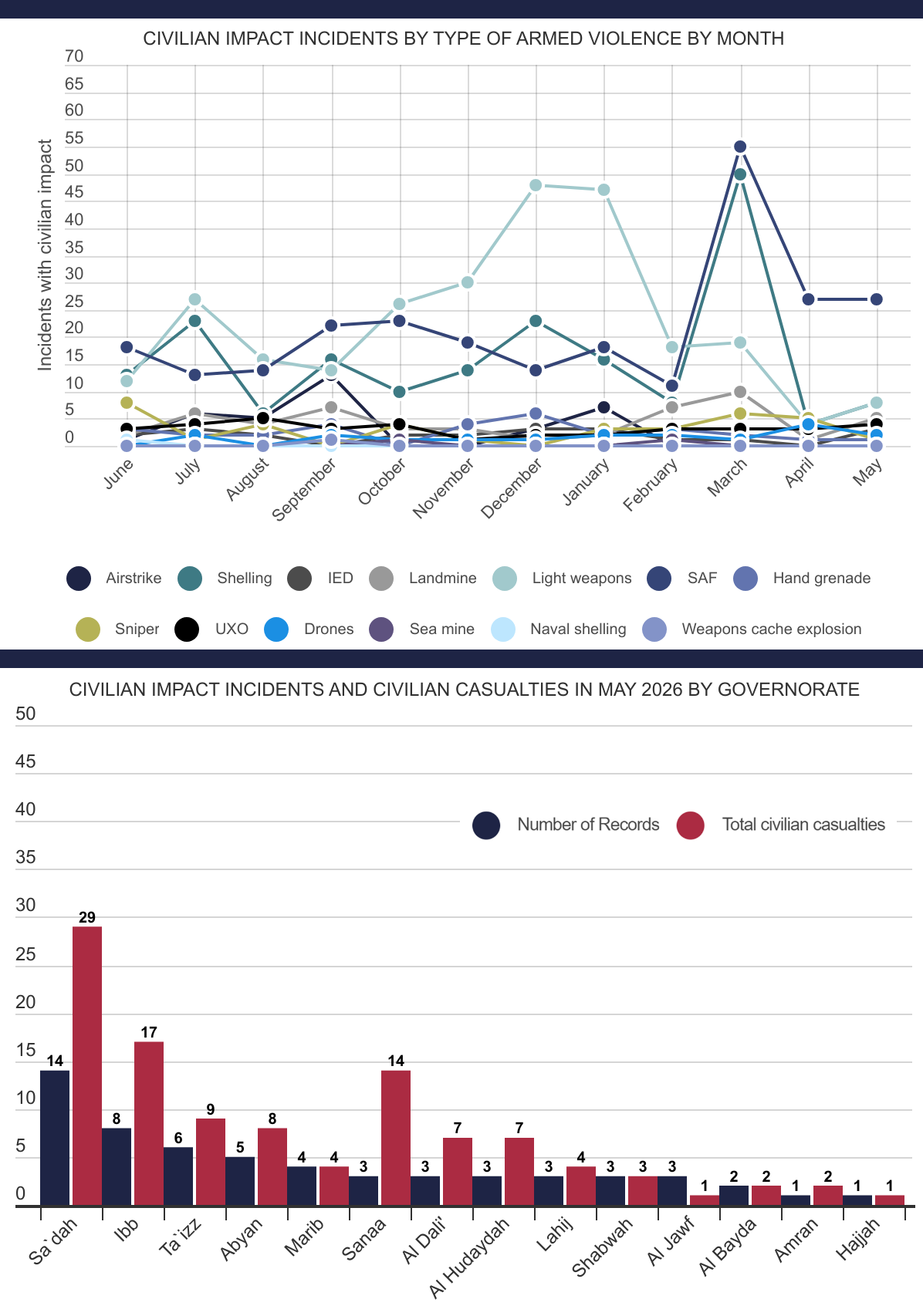
Heavy shelling, medium calibre weapons fire, drone strikes, and sniper fire caused a total of 31 civilian casualties along the country’s active frontlines in May, around a third of the total civilian casualty toll (29%) from armed violence. While the number was 29% higher than the previous month (24), it was down by 43% compared to the monthly average for this year (54). Sadah accounted for the vast majority (80%) of the month’s frontline casualties (26), double the dead and wounded that the governorate saw in April (13). But despite the uptick, May was the second-lowest monthly figure the governorate has seen in 2026.
In Taizz, meanwhile, the number of dead and wounded civilians from frontline hostilities fell significantly this month, dropping from 11 to 2. Hostilities were still ongoing in the governorate, primarily in the eastern and southern outskirts of Taizz city and in Maqbanah district to the west of the city, but at a lower level than in previous months. Frontline hostilities were also reported in northern Ad Dali, Hajjah, and Marib, but with few direct civilian casualties. Of note, in northern Lahij on the border with Taizz, fighting resulted in injuries to a child, marking the first time that frontline violence impacted civilians in the area since October 2025.
Overall, although the geographical range of hostilities was wider than the previous month, the number of civilian frontline casualties was lower in all governorates except for Sadah. With that being said, the coming weeks are unlikely to see casualty numbers in Sadah increase significantly, as there are currently no indications that hostilities will escalate in the northern governorate in the short term. Instead, casualties are more likely to climb gradually over the coming months, unless airstrikes resume or a mass casualty event is reported.
Ibb saw the highest number of shooting victims in four years
Half of the month’s casualties (53) were the result of incidents related to small arms fire (SAF), marking the second month in a row that SAF victims were higher than those caused by frontline hostilities. However, that number was 17% lower than a month earlier (64) and 17% lower than March (57). So far, in 2026, a total of 246 civilians fell victim to incidents of armed violence unrelated to the overall conflict, almost two-thirds more (60%) than the first five months of 2025 (154).
Ibb saw the highest number of deaths and injuries (17) from shootings in May, more than the next two governorates combined (Abyan, 8; Taizz, 7). This is the highest number of civilian victims resulting from shootings in Ibb since March 2022, with the governorate this year witnessing the third highest casualty toll from isolated shootings and hand grenade blasts (27), after only Taizz (39) and Amran (33).
The main reason for the increase in shooting victims in Ibb this month was an incident that caused 8 casualties when an individual shot 2 civilians in As Sabrah district to the southeast of the governorate, before fleeing to Ibb city, where a further 6 civilians were injured when the suspect detonated a hand grenade while resisting arrest. As such, the spike in the governorate may be temporary, and the rate of SAF and grenade incidents in Ibb may fall in the coming weeks. However, countrywide, a steady rate of shootings is expected to continue as there have been no indications of any improvement in the general security situation.
ERW casualties more than doubled compared to April
A total of 24 civilians were the victims of landmines, Unexploded Ordnance (UXO), and IEDs in May, more than double the tally reported in April (9). A single incident in Sanaa was responsible for the increase, when a longstanding land dispute led to armed groups demolishing a guard’s quarters located inside a farm, killing and injuring 12 civilians. Another 7 civilians, all children, were the victims of UXO blasts in Ad Dali, Al Hudaydah, and Sanaa. Of all the civilians killed and injured as a result of ERW in 2026 (80), nearly half (40%) were children (29) and women (3).
Although ERW victims in 2026 are lower than the same period last year (93), the percentage of children and women casualties (37) has been identical (40%) to this year, indicating that the dynamics leading to Explosive Remnants of Warfare (ERW) incidents have remained unchanged. Children are the most vulnerable to ERW blasts, especially to UXO that still contaminates farmlands and livestock grazing areas, as children tend to mistake military ordnance for toys or reusable material. Landmines are the most common cause of ERW blasts, accounting for half of the casualties in the first five months last year (46) and over a third (38%) so far in 2026 (30).
Regional conflict has reduced fuel imports to Yemen, leading to price hikes
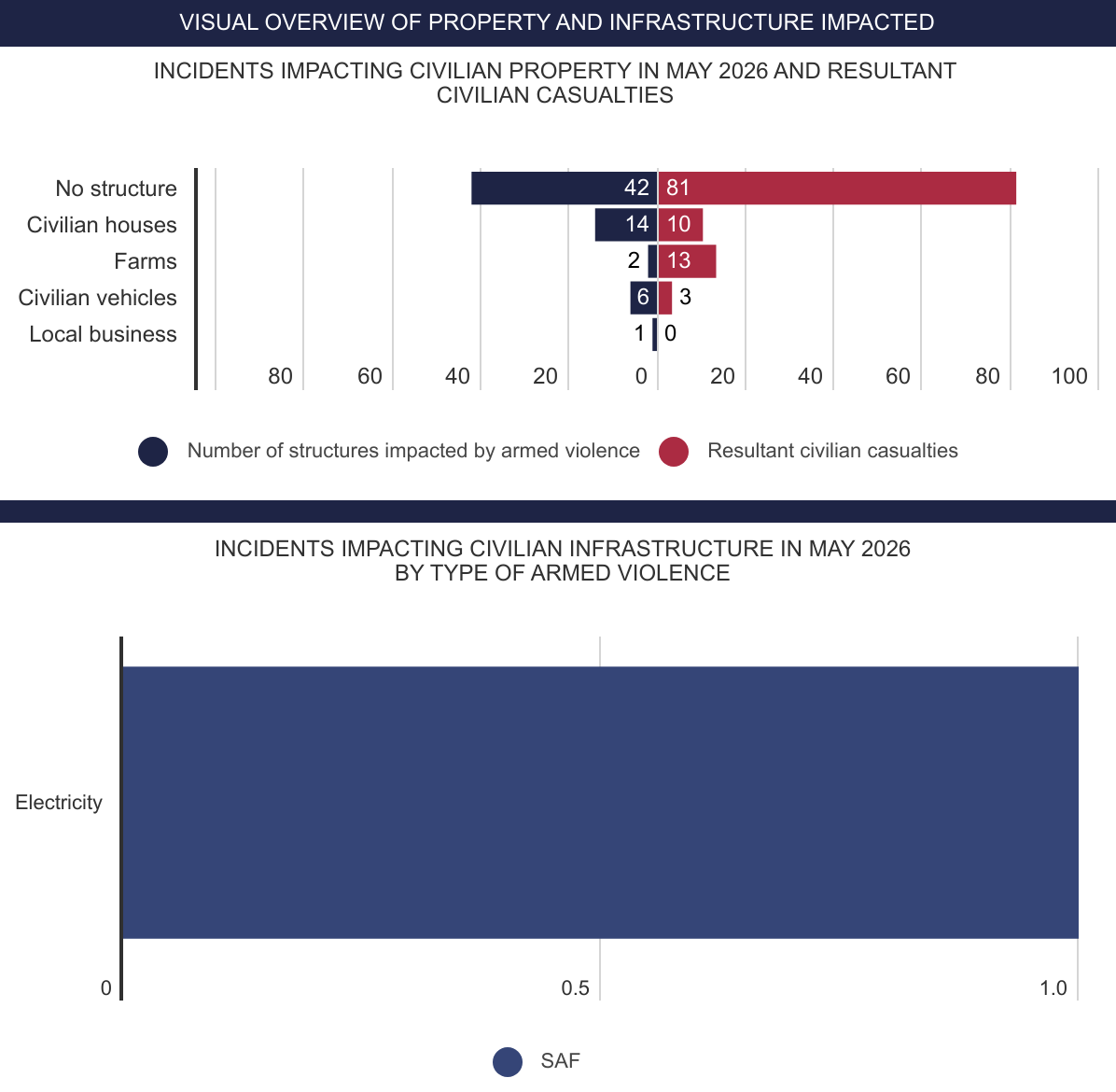
Reports indicated that the negative impacts of the regional conflict continue to have a significant impact on Yemen. The blockade of the Strait of Hormuz has led to a decrease in fuel imports, with the Al Hudaydah ports witnessing a 76% fall in fuel shipments between January and April compared to the same period in 2025. There was also a 45% decrease in fuel deliveries to ports in the south, which partially contributed to fuel shortages and a spike in fuel prices in April. Although the decrease in fuel deliveries has not led to reported shortages in the north, the situation has been significantly different in the south. Electricity blackouts increased in southern cities, with Aden experiencing up to 18 hours of power outages per day, while cities in Abyan and Lahij went days without electricity.
Protests were reported every week of the month, but for the most part were largely spontaneous and unorganised, sparking little to no backlash from the local authorities. Political rallies were also a near-weekly occurrence, but no protest-related violence was reported throughout the month. However, as public services are likely to continue to falter in the coming period, protests are expected to grow, posing a risk of violence if the authorities attempt to disperse large gatherings or remove roadblocks, especially in non-designated protest areas or when security forces feel threatened by crowds.
|
|
|
|
|
|
|
|
|
|
|
|
|
|
|
The Civilian Impact Monitoring Project is a monitoring mechanism for the collection, analysis and dissemination of open source data on the civilian impact from armed violence in Yemen, in order to inform and complement protection programming.
|
|
|
|
|
|
|
Click here to subscribe to our flash, daily and weekly reporting,
or visit our website here.
For further information, please contact us at contact@civilianimpact.org.
|
|
|
|
|
|
|