|
|
|
|
This is the Civilian Impact Monitoring Project's monthly visual and analytical report, providing an overview of all incidents of armed violence reported to have directly impacted civilians in Yemen in March 2026. The report covers civilian casualties, incident distribution, types of armed violence, and impacts on civilian property and infrastructure.
|
|
|
NATIONWIDE SNAPSHOT: CIVILIAN IMPACT FROM INCIDENTS OF ARMED VIOLENCE
|
|
|
|
|
|
|
Civilian Impact Incidents
Civilian Casualties* (Fatalities / Injuries)
Child Casualties (Fatalities / Injuries)
Women Casualties (Fatalities / Injuries)
|
|
|
|
|
|
48
147 (42 / 105)
28 (12 / 16)
15 (5 / 10)
|
|
|
|
|
|
|
Compared to previous month
|
|
|
|
|
|
Compared to 2026 monthly average
|
|
|
|
|
|
|
|
|
*Please note, all information and numbers included in CIMP reporting are based on information publicly available in open sources, and have not been independently verified
|
|
|
|
|
|
|
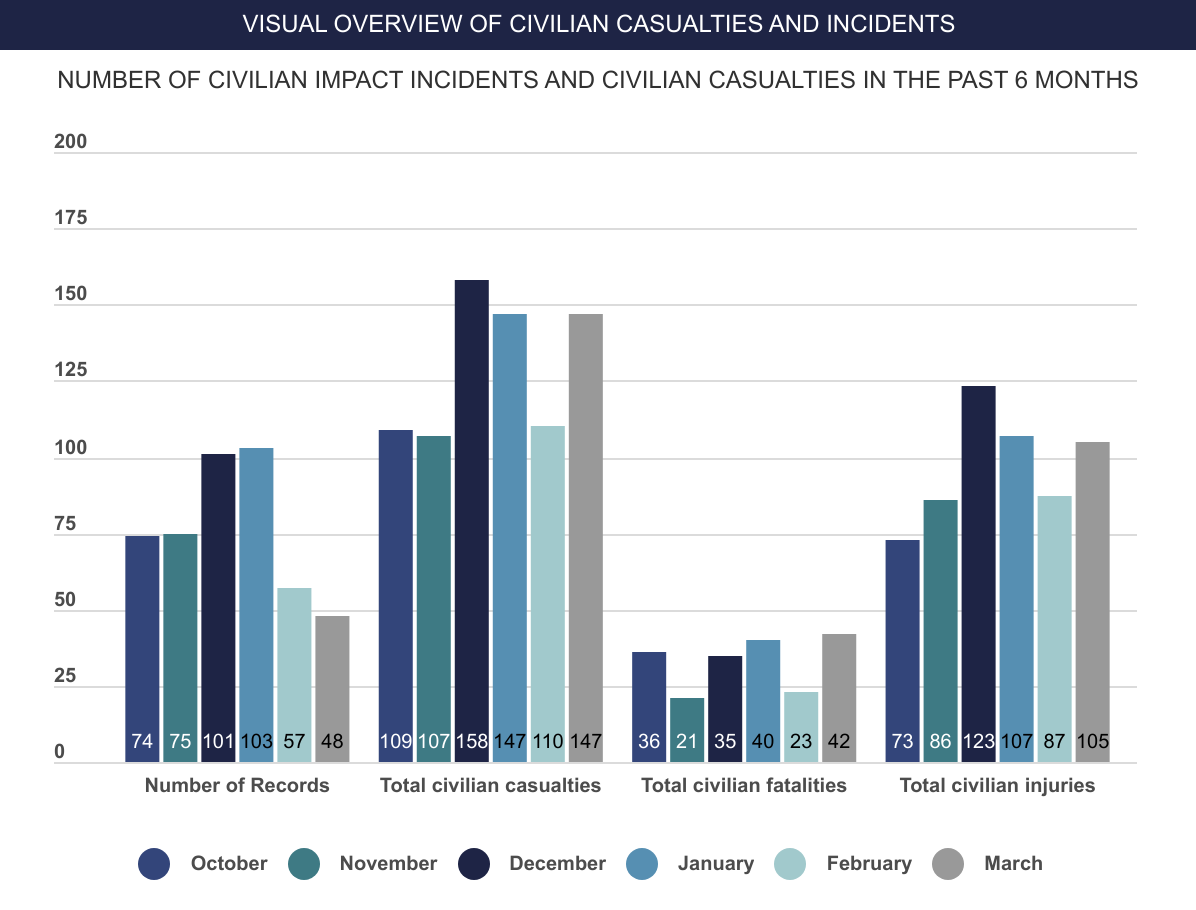
March marked an increase in civilian casualties compared to the previous month
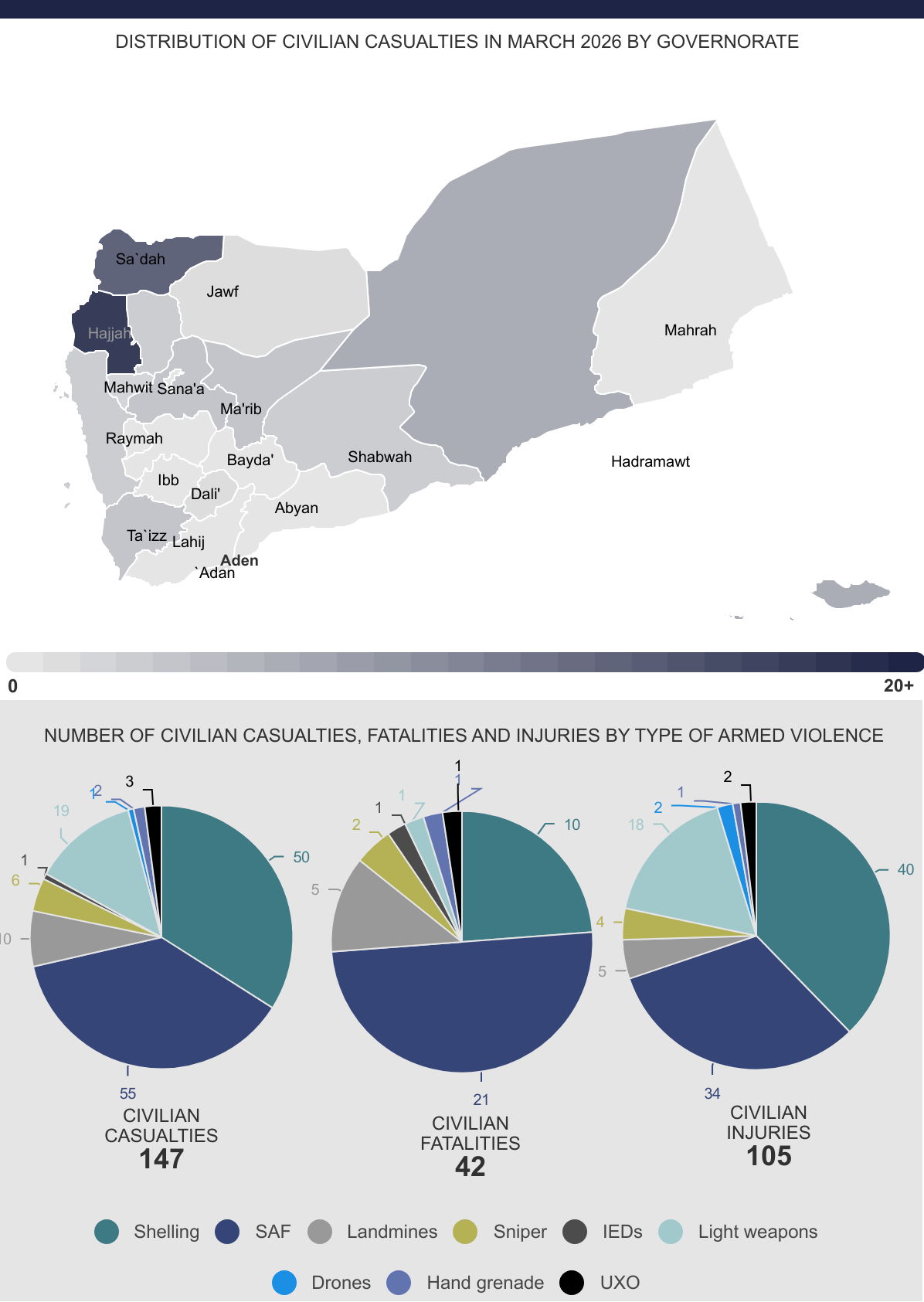
Although no military escalation was reported during the month, March saw a casualty rate (147) closer to the December (158) and January (147) numbers, when aerial bombings in the south resulted in multiple civilian casualties, than the tally during February. One of the primary drivers behind the increase was a shellfire incident in Hajjah that left 38 civilians dead and wounded, the most in a single incident so far this year. Additionally, there was an increase in the number of casualties caused by isolated shootings by nearly two-thirds (58) compared to February (36), the most in a month since June of last year.
Meanwhile, child and women deaths and injuries (43) spiked to the highest since the September airstrikes, mainly due to small arms fire (SAF)and ERW incidents. This number may continue to rise as drone and missile launches from Yemen resumed at the end of the month in response to the regional conflict, increasing the risk of retaliatory airstrikes, in which civilian victims would likely be high, with a significant proportion of the casualties being children and women.
Around half of the civilian casualties in March were along active frontlines
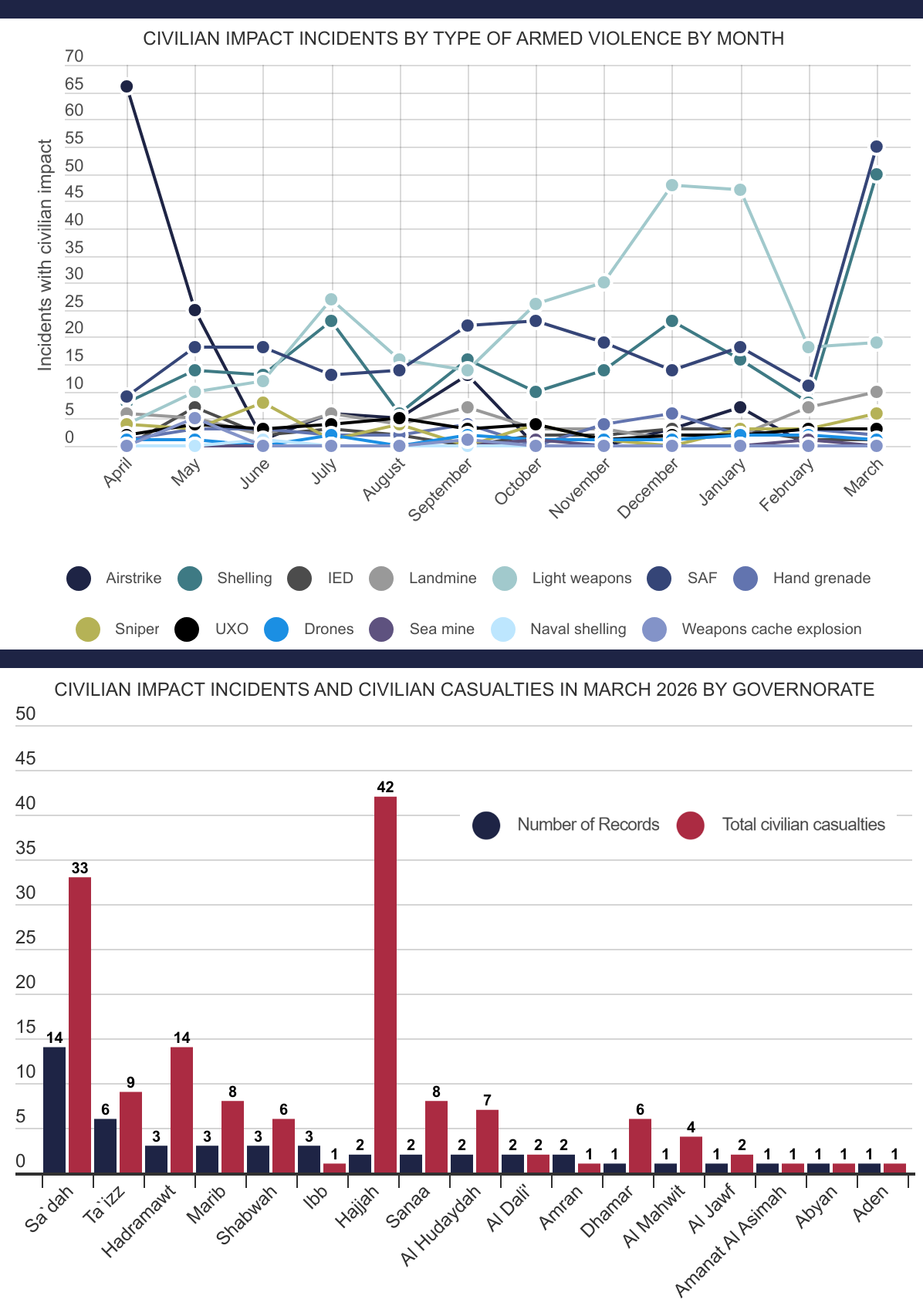
Frontlines across the country continued to witness growing military activity, with this month’s civilian casualties (76) increasing by more than a third (37%) compared to February (48). Hajjah accounted for the highest number of casualties, primarily due to the shelling incident in which 38 civilians were killed and injured by heavy artillery. The incident occurred in an area between Hayran and Abs districts in the centre of the governorate, a long-dormant frontline that last saw sustained hostilities in March 2022. It is assessed that the shelling was an attempt to thwart a possible incursion, rather than an intentional targeting of civilians, as the gathering was relatively large for a frontline area and may have been mistaken for a military move. No further hostilities have since been reported in the governorate.
Sadah saw the second-most casualties (30), but this was still the lowest monthly civilian casualty rate in the governorate since April 2025. It is also the fourth consecutive month that casualties in Sadah have been dropping. The fall in civilian victims in Sadah has come after a gradual but steady decline over the past three months. However, the monthly decrease may not necessarily continue as previous lulls in the governorate, including last year, have been followed by spikes.
Meanwhile, the southeastern areas of Al Hudaydah, in Hays and Jabal Ras, have seen an escalation in fighting over the past month, with clashes resulting in multiple military casualties, but limited civilian casualties so far. The objective appears to have been to take over Hays city and further attempts can be expected in the coming period. Similarly, in Taizz city, as many as 20 soldiers were killed and injured during an incursion to the west of the governorate capital on 13 March. The intent also seems to have been to try to capture territory rather than reinforce current positions. As such, military deployments in both Al Hudaydah and Taizz have seen a tactical shift since mid-February, away from reinforcing existing positions and towards expanding lines of control and seizing additional territory. However, to date, these attempts have been short-lived and have not led to sustained hostilities, but further attacks can be expected, especially if the regional conflict continues to escalate.
Isolated incidents resulted in a third of the total casualties this month
The second leading cause of civilian casualties during March has been isolated shootings (57), making up around 40% of all the dead and wounded. The number was also around a third (38%) higher than the previous month (36). Hadramawt saw the most civilian victims (14) from shootings, followed by Amran (7), while Marib, Sanaa, Shabwah, and Taizz accounted for 6 casualties each.
The spike in Hadramawt was partly caused by an incident at the critical Al Khashaah junction, where a vehicle came under fire at a checkpoint, leading to 7 casualties. Despite the increased security presence along the main roads in the governorate since the widespread military deployments in December and January, the incident was the first instance of checkpoint violence in Hadramawt this year.
In total, 21 children (11) and women (10) were among the victims of isolated shootings, making up three-quarters of the month’s deaths and injuries among children and women. The number was also double that reported in both February (11) and January (10) from small arms fire (SAF), with family disputes, stray bullets, and checkpoint violence the leading causes for casualties among vulnerable groups.
ERW incidents saw a considerable drop in March
The reporting period saw ERW victims (14) drop by almost 50% compared to February (26), but compared to last month’s high, the March total was more in line with the average (15) for the past six months. Children and women made up nearly all of the casualties (13), with Al Hudaydah (6) and Hajjah (4) witnessing the most victims. So far in 2026, Al Hudaydah has seen a total of 30 civilian victims from ERW incidents, around a quarter (23%) of whom have been children (5) and women (2).
The remaining victim this month was reported in Sanaa city, where an IED blast killed a 20-year-old man. The explosion was reported near the Al Jiraf police station in the north of the city, where a motorcycle driver delivered a package to the area. The explosive inside the parcel was reportedly remotely detonated, but it only killed the delivery driver. It is believed that the deliveryman had no prior knowledge of the package’s contents, nor did he detonate the device himself. Further assessment indicates that the incident was a one-off, as there have been no indications of any Violent Extremist Organisations (VEO) connection to the explosion.
Protests and political tensions continued throughout the south
During March, political rallies continued in Aden and Hadramawt. Although the risk of protest-related violence remained, no protesters were killed or injured. At the start of the month, demonstrators gathered in front of the Presidential Palace in Aden, demanding the release of protesters detained at a rally two weeks earlier that broke out into violence, leaving dozens of people dead and wounded, both soldiers and protesters. Surveillance drones were reportedly shot down in the vicinity of the Palace during the latest protest, with debris falling near residential areas, but no civilians were affected, and no further similar incidents have since been reported.
Protests were also held over both the political situation and the payment of civil servant salaries in several governorates. The demonstrations were peaceful; however, there were reports that security personnel forcibly removed protesters from sit-ins in Aden and Marib. No firearms were involved, but security personnel did resort to violence to force protesters to leave the areas, resulting in several injuries.
In relation to the lingering political tensions in the south of the country, trucks loaded with small arms and light weapons were looted in Halimayn district on the northeastern border between Lahij and Ad Dali. The weapons were reportedly being transported as part of an official military escort, but were ambushed by personnel from the same convoy, leading to clashes that left 6 dead and wounded. Internal divisions within the restructuring military remain and are likely to lead to further limited infighting. There were also reports of military deployments in Abyan, Lahij, and Al Mukha in western Taizz, but the deployments proceeded without resistance from opposing political sides.
The coming period is likely to continue to witness protests and political rallies across the south, with protest-related violence remaining possible. However, it is assessed that, as the government continues to restructure and reintegrate parts of southern political and security factions into its official ranks, the risk of renewed political violence will persist but steadily diminish, as has been the case since January.
Drone and missile launches from Yemen briefly restarted on 28 March
The most notable development during the month was the temporary resumption of drone and missile launches from Yemen in response to the wider regional conflict. The broader conflict restarted on 28 February, but no involvement from Yemen was reported until 28 March. Although the month ended without reports of retaliatory airstrikes, such strikes are expected if cross-border attacks continue, even if regional hostilities pause or end in the coming period. The targets for any air raids will likely be political figures and major economic infrastructure, with a high risk of significant civilian impact, particularly if the targets are located in densely populated areas.
Meanwhile, the UN mission in Al Hudaydah concluded its mandate on 31 March, bringing to an end its oversight of the implementation of the 2018 Stockholm Agreement. The closure coincided with ongoing regional hostilities, but the absence of the UN mission will not affect whether the warring parties escalate on the ground in the coming weeks. Instead, the wider regional dynamics will have a greater influence on the frontlines, especially on the west coast, which may see localised moves to secure territory, similar to the fighting seen in Hays district over the past two months.
|
|
|
|
|
|
|
|
|
|
|
|
|
|
|
The Civilian Impact Monitoring Project is a monitoring mechanism for the collection, analysis and dissemination of open source data on the civilian impact from armed violence in Yemen, in order to inform and complement protection programming.
|
|
|
|
|
|
|
Click here to subscribe to our flash, daily and weekly reporting,
or visit our website here.
For further information, please contact us at contact@civilianimpact.org.
|
|
|
|
|
|
|