|
|
|
|
This is the Civilian Impact Monitoring Project's monthly visual and analytical report, providing an overview of all incidents of armed violence reported to have directly impacted civilians in Yemen in June 2026. The report covers civilian casualties, incident distribution, types of armed violence, and impacts on civilian property and infrastructure.
|
|
|
NATIONWIDE SNAPSHOT: CIVILIAN IMPACT FROM INCIDENTS OF ARMED VIOLENCE
|
|
|
|
|
|
|
Civilian Impact Incidents
Civilian Casualties* (Fatalities / Injuries)
Child Casualties (Fatalities / Injuries)
Women Casualties (Fatalities / Injuries)
|
|
|
|
|
|
60
104 (34 / 70)
26 (11 / 15)
12 (7 / 5)
|
|
|
|
|
|
|
Compared to previous month
|
|
|
|
|
|
Compared to 2026 monthly average
|
|
|
|
|
|
|
|
|
*Please note, all information and numbers included in CIMP reporting are based on information publicly available in open sources, and have not been independently verified
|
|
|
|
|
|
|
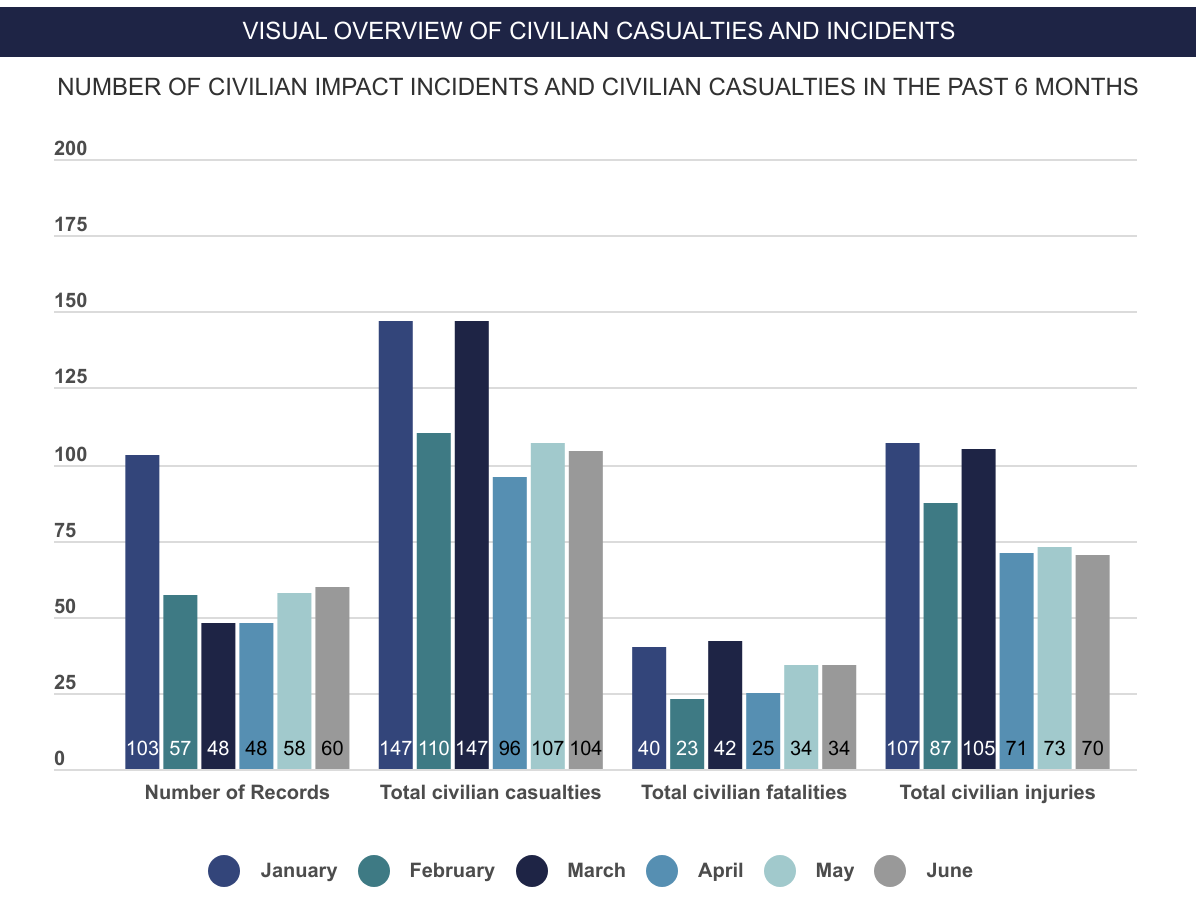
Civilian casualty numbers remained similar to May, but children and women casualties increased
The number of civilian casualties reported in June (104) were similar to May (108), with the main drivers of the month’s casualty numbers remaining largely unchanged, predominantly frontline hostilities and shooting incidents. Also unchanged from May, 34 civilian fatalities were reported. However, children and women casualties spiked to 38, a 43% increase from May (21). One in four (26) of the civilian casualties reported in June was a child. This is the second highest child casualty count this year after March (28), and over a third (37%) higher than the monthly average number of child casualties reported to date in 2026. The main reason for the increase in child casualties was a UXO blast in Ad Dali which left 12 children killed and injured in a single incident. June also saw the second highest monthly casualty count among women to date this year, at 12, following 15 in March, and fourfold the three reported in May. Dispute-driven violence and isolated shootings accounted for all but one of the women casualties.
Frontline violence results in similar civilian casualty count to May, driven primarily by border violence in Sadah
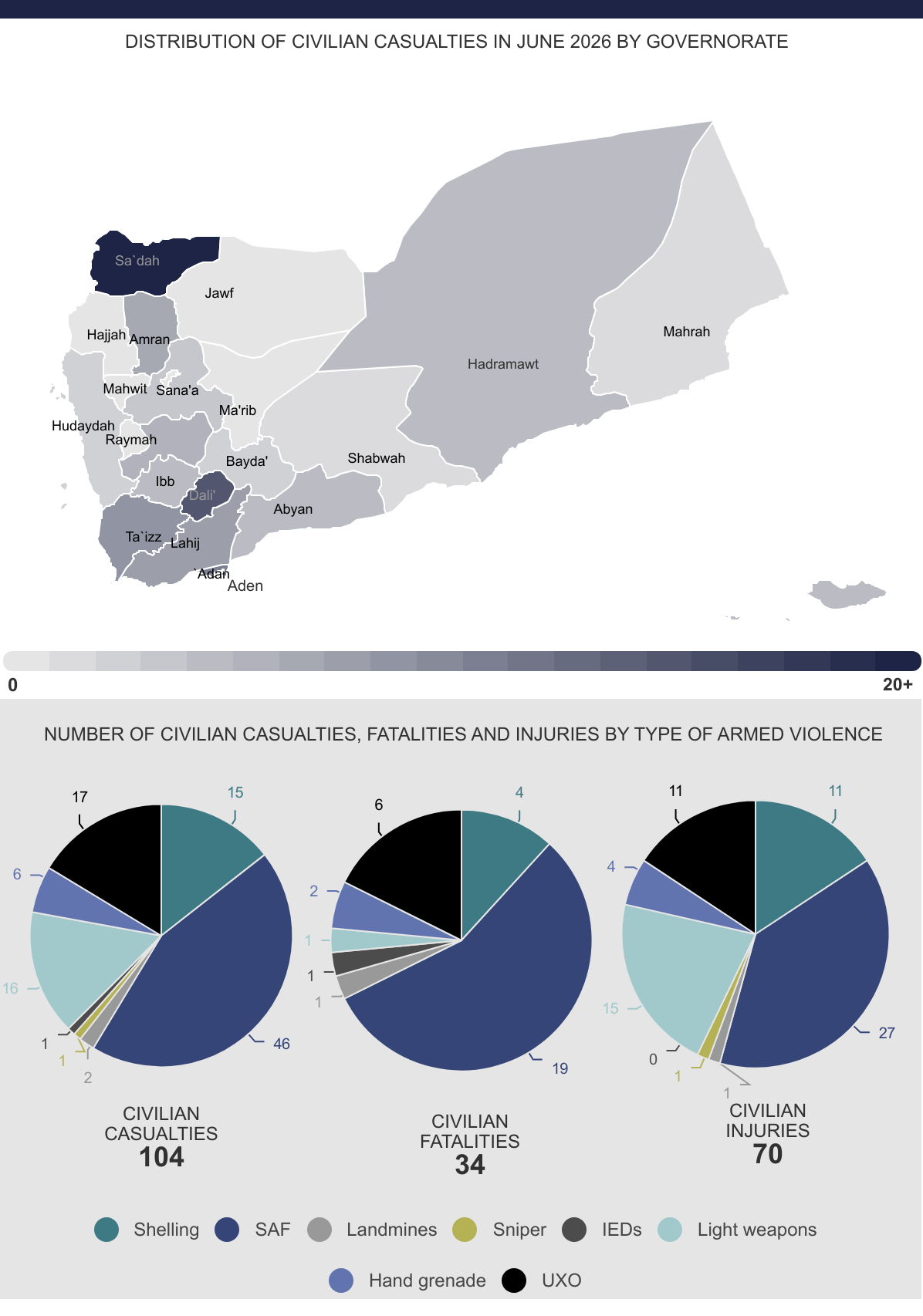
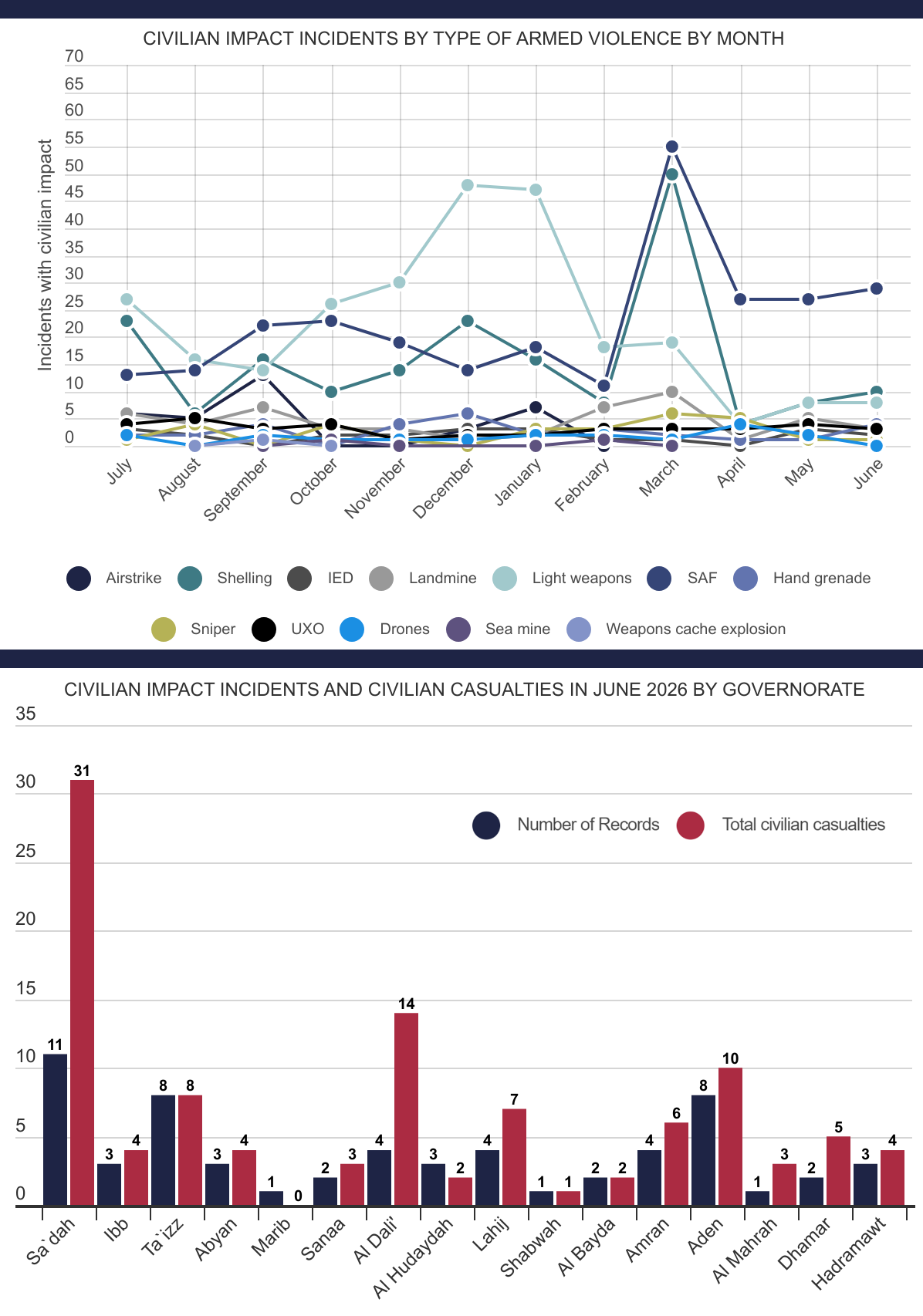
There was no notable change in civilian casualty numbers as a result of frontline violence from last month. In June, frontline hostilities were responsible for a reported 32 civilian casualties, similar to the 31 reported in May, but a third higher than in April (24). The sustained high numbers are predominantly being driven by continued violence in Sadah, where 26 civilians were killed and injured in each of May and June. This came after four consecutive months of declining casualty numbers in the northern governorate; a trend that changed in May, when casualties in Sadah more than doubled from 11 to 26. In June, 12 migrants were reported among the casualties in Sadah, the highest migrant casualty count to have been reported in three months. A reported 62 migrants have been killed or injured along the Sadah border to date this year, 50% higher than the same period in 2025 (41), excluding casualties from the bombing of the Sadah detention centre in April 2025.
Elsewhere in the country, fighting continued along the usual flashpoints, including in northern Ad Dali, southern Al Hudaydah, the border between Lahij and Taizz, and southern Marib on the border with Shabwah. Taizz saw the lowest civilian casualty count from frontline violence since September 2025. Nonetheless, one child was injured along the frontlines in Maqbanah district. Meanwhile, Al Hudaydah saw the first instance of frontline fighting impacting civilians since March, with two civilian casualties reported along the governorate’s southern borders. Frontline fighting remains characterised by limited bouts of sudden but short-lived offensives. These dynamics are unlikely to change in the short to medium term, but any breakdown in the regional risks an escalation both domestically and regionally.
12 children killed and injured in mass casualty UXO incident
On 22 June, an unexploded ordnance (UXO) blast in Ad Dali killed five children and injured another seven children, all aged between 7 and 13. The explosion was caused by the children tampering with the device, having misidentified the ordnance as a reusable material, a common trend that has characterised UXO explosions, especially among children. The incident accounted for more than half of the 19 civilian casualties reported from explosive remnants of warfare (ERW) in June. ERW has been responsible for 85 civilian casualties in Yemen during the first six months of 2026, matching the 86 reported in the first six months of 2025. However, the proportion of women and children among the casualties has increased. Over half (50, 58%) of the ERW casualties reported to date this year have been women and children, compared to 37% during the same period last year. Of the 163 women and children killed and injured by armed violence to date in 2026, around a third (31%, 50) have been caused by ERW.
For the second consecutive month, small arms fire incidents resulted in 46 civilian casualties
As has been the case with frontline violence, civilian casualties from small arms fire (SAF) incidents were unchanged from May, at 46. Over a third of the SAF casualties (17, 37%) were children and women. Incidents were dispersed across 14 of Yemen’s governorates, with Taizz and Aden seeing the highest figures, each with seven civilian SAF casualties reported. So far in 2026, Taizz has seen the second highest SAF casualty numbers, at 37, on a par with the 38 SAF casualties reported in Amran to date this year.
Amid ongoing power outages, protest-related violence was among the drivers of SAF casualties in Aden this month. Prior to June, protests across the south of Yemen had been relatively small and informal, sparking little if any response from the authorities. However, by the first week of June, protests started to gather in a more organised manner, amid demands for improved public services. In Aden, protestors blocked main roads with burning tyres, and on 8 and 9 June, security forces opened fire at protesters, injuring two. Similarly, in Hadramawt, a protester was shot dead by authorities in Sayun, and another was injured. Several protesters were also arrested in the southern cities. Nonetheless, political rallies in Aden and Hadramawt continued, with authorities again using live fire to disperse crowds in Aden, Al Mukalla, and Sayun on 20 June, wounding at least three more civilians in Aden. To date in 2026, 13 people have been killed or injured in protest-related violence, already over double the number reported in all of 2025 (6). Amid continued disruptions in the Strait of Hormuz, fuel availability remains heavily impacted, particularly in the south of the country, driving continued power failures. With no end in sight to the regional conflict, fuel scarcity is likely to continue driving public protests and reducing economic activity in the south of the country.
|
|
|
|
|
|
|
|
|
|
|
|
|
|
|
The Civilian Impact Monitoring Project is a monitoring mechanism for the collection, analysis and dissemination of open source data on the civilian impact from armed violence in Yemen, in order to inform and complement protection programming.
|
|
|
|
|
|
|
Click here to subscribe to our flash, daily and weekly reporting,
or visit our website here.
For further information, please contact us at contact@civilianimpact.org.
|
|
|
|
|
|
|