|
|
|
|
This is the Civilian Impact Monitoring Project monthly visual and analytical report, providing an overview of all incidents of armed violence reported to have had a direct impact on civilians in Yemen in October 2025. The report covers civilian casualties, incident distribution, type of armed violence and impact upon civilian property and infrastructure.
|
|
|
NATIONWIDE SNAPSHOT: CIVILIAN IMPACT FROM INCIDENTS OF ARMED VIOLENCE
|
|
|
|
|
|
|
Civilian Impact Incidents
Civilian Casualties* (Fatalities / Injuries)
Child Casualties (Fatalities / Injuries)
Women Casualties (Fatalities / Injuries)
|
|
|
|
|
|
74
110 (36 / 74)
15 (4 / 11)
12 (4 / 8)
|
|
|
|
|
|
|
Compared to previous month
|
|
|
|
|
|
Compared to 2024 monthly average
|
|
|
|
|
|
|
|
|
*Please note, all information and numbers included in CIMP reporting are based on information publicly available in open sources, and have not been independently verified
|
|
|
|
|
|
|
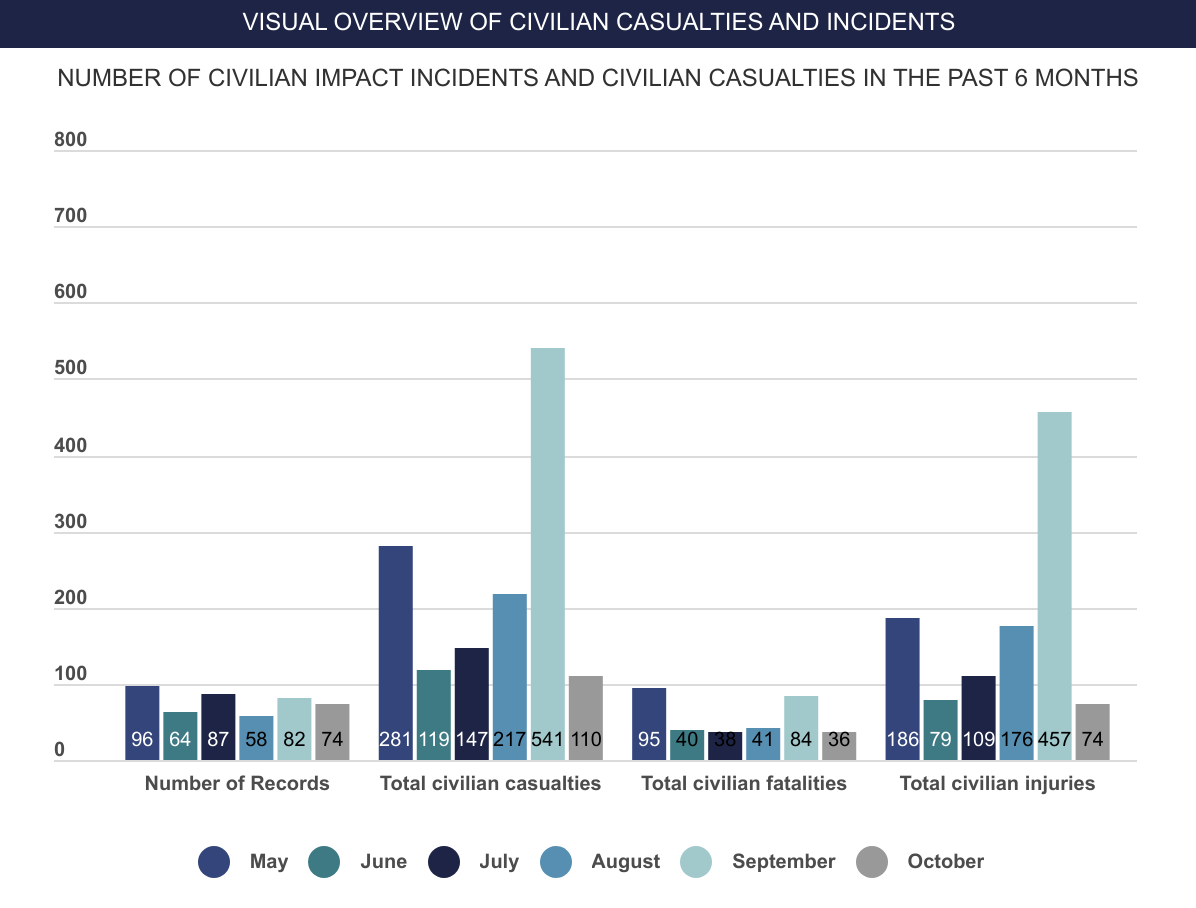
October marked the second-lowest casualty count this year
The reporting period saw a sharp decrease in casualty rates. A total of 110 civilian casualties were recorded, marking the second-lowest casualty toll this year after February (57). The number was also around half the monthly average (239) so far in 2025 and 80% lower than the month before (541). Children and women casualties (27) fell proportionately, dropping by around 90% compared to September (210). Nonetheless, with this month’s count, the first 10 months of 2025 have now resulted in the third-highest number of civilian victims (2,387) since 2019, when a total of 2,864 casualties were reported in the same time frame.
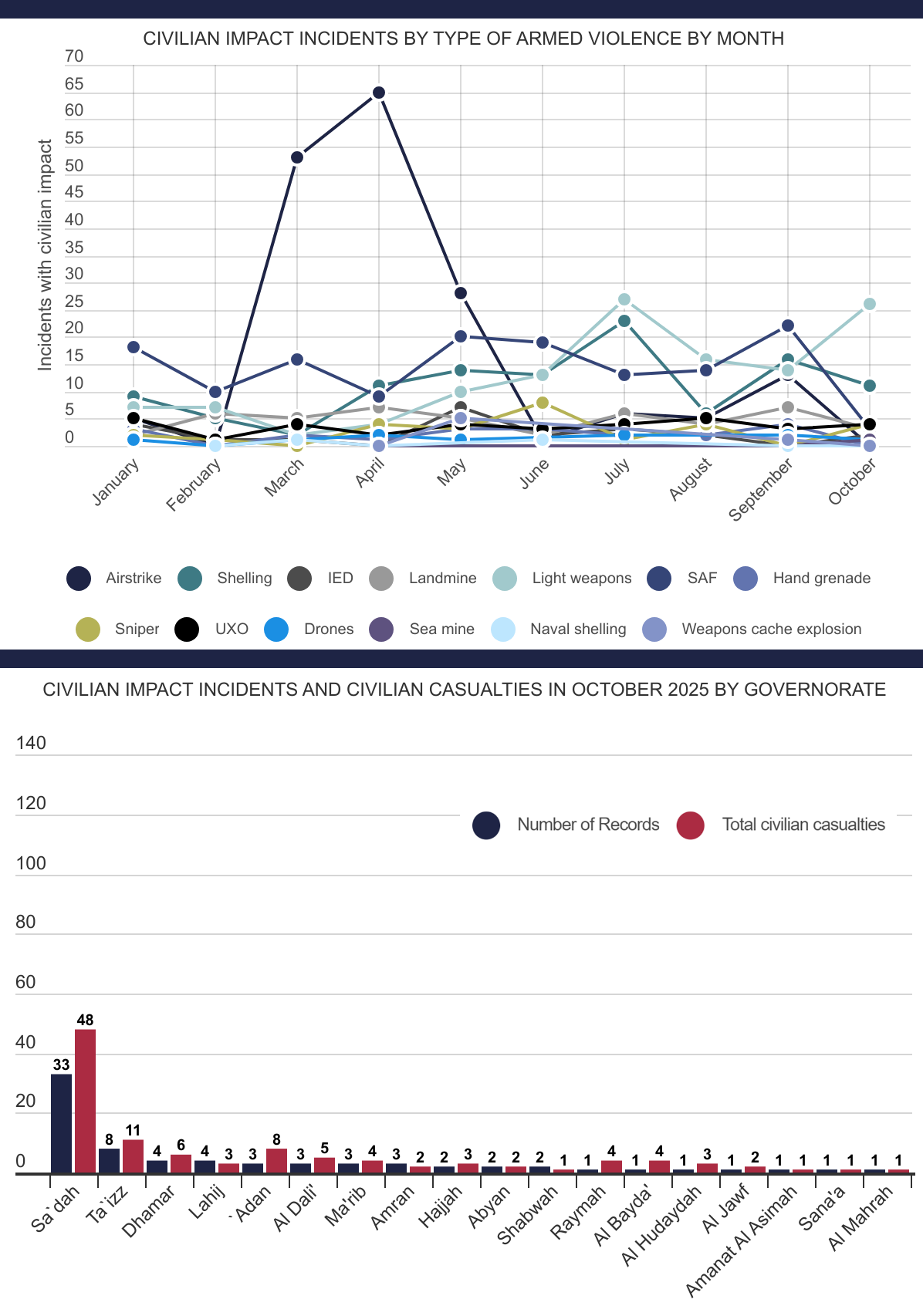
The leading cause for the drop in casualty numbers has been the cessation of airstrikes, with the last air raids reported on 25 September. The regional truce that came into effect on 10 October further lowered the risk of airstrikes as both the air raids in Yemen and the related maritime escalations in the Red Sea have been connected to wider regional developments. As such, it is expected that as long as the regional ceasefire holds, the risk of renewed airstrikes will be low. However, the possibility of one-off bombings cannot be ruled out, especially following recent heightened rhetoric around airstrikes and missile and drone launches. If airstrikes resume, civilian casualties should be expected to climb significantly.
Frontline hostilities increased by a third compared to September
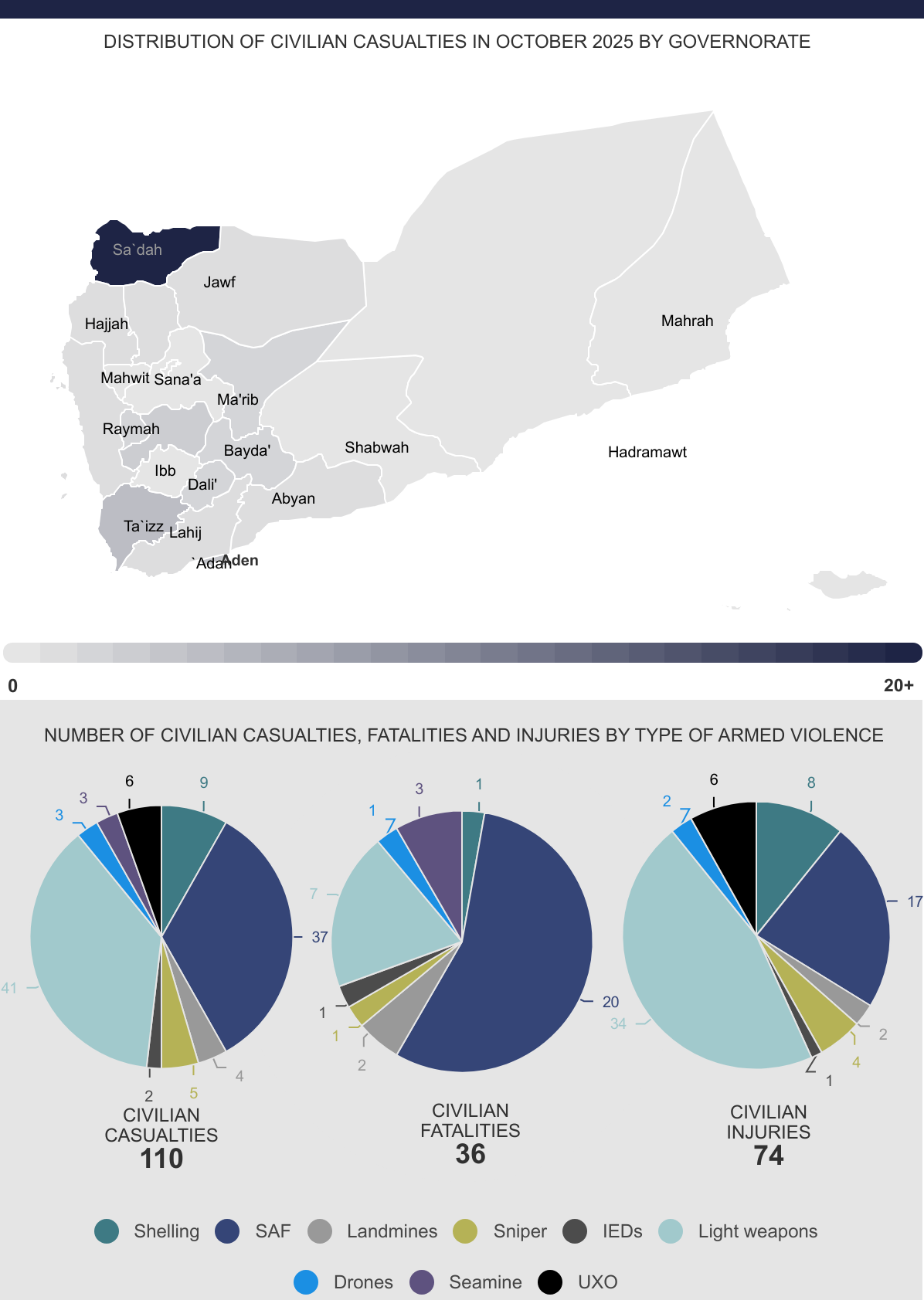
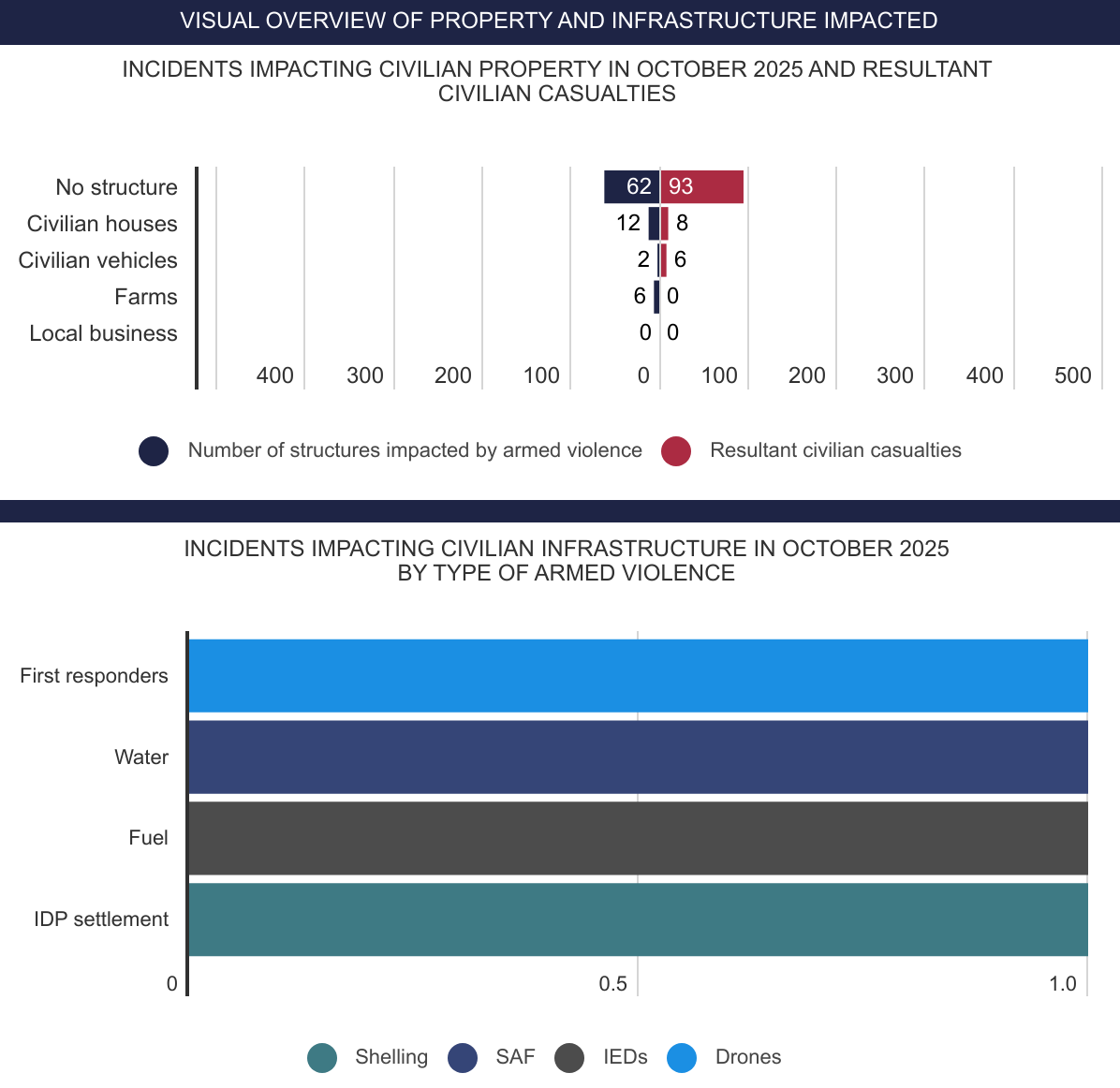
The main driver of civilian impact during October was frontline violence, which accounted for around a half (58) of all civilian casualties in the month, up by around a third compared to September (38). Sadah again saw the highest number of casualties (47) along active frontlines, including 18 migrants, followed by Taizz (6). October also marked the first time since July that hostilities resulted in civilian casualties in Ad Dali; 3 civilians were injured when drone strikes hit an ambulance in the west of the governorate. The incident marked the first incident impacting first responders since airstrikes on the Ras Isa port in April, killing 6 and wounding 2 more. Additionally, cross-border violence in Sadah impacted an IDP camp, but there were no reports of deaths or injuries among IDP populations along the northern borders of the governorate.
Overall, the number of civilian casualties from frontline hostilities was the highest since July and the third-highest this year. The uptick can be partly explained by an increase in the frequency of reporting from the northern and northwestern districts of Sadah, likely linked to illegal movements along border areas rather than a deliberate targeting of civilians or civilian infrastructure. In Taizz, there was a slight increase in casualty numbers compared to September (1), attributed mainly to increased incidents of sniper fire along frontlines in the outskirts of Taizz city. In addition to that, the uptick in frontline violence was coupled with increased military activity in Ad Dali, Al Jawf, Marib, Shabwah, and Taizz. As a result, there is a possibility that ongoing military movements in the coming period will lead to further incidents, impacting civilians near the frontlines, with shelling and sniper fire causing the highest impact.
Isolated shootings caused a third of the month’s civilian victims
Armed violence caused by shootings dropped by around 15% compared to September (41), but still resulted in a third of the month’s casualties (37). A total of 22 shooting incidents were reported, with disputes accounting for around half of the total casualties (18), followed by personal grievances (9), crossfire (9), and checkpoint violence (1). Among the casualties were 6 children (3 killed; 3 injured) and 8 women (4 killed; 4 wounded), in addition to 2 migrants. Children and women victims of shootings during October were similar to the month before (14) and only slightly lower than August (17), maintaining the trend of more than double the monthly average (6) for the year. The uptick in children and women casualties can be mainly attributed to an increase in familial violence in recent months.
As of October, there have been 318 civilians killed or injured by small arms fire (SAF), the third leading cause of civilian casualties this year after airstrikes (1,311) and frontline violence (465). This is also the third-highest number of civilian victims caused by SAF in the first 10 months of a year since 2018. Ibb has witnessed the highest number (16%) of SAF casualties this year (51), followed by Taizz (30), then Hadramawt (26). It is expected that the coming period will continue to witness SAF incidents, with disputes causing the highest casualties.
October saw the first sea mine incident in 3 years
The coast of Kamaran Island, to the northwest of Al Hudaydah, saw a sea mine incident on 24 October, the first sea mine explosion to cause civilian casualties since January 2021. In total, there were 15 civilians killed and injured as a result of Explosive remnants of war (ERW) in October, around a third (38%) lower than the previous month (24). Aden, Al Hudaydah, and Marib each saw 3 casualties, followed by Al Jawf (2 casualties). The incident in Aden marked the second time this year that an Unexploded Ordnance (UXO) incident has been reported in the city.
So far in 2025, there have been a total of 175 civilian casualties caused by ERW, with Al Jawf witnessing the highest number (39), followed by Al Hudaydah (34), then Taizz (20). This is a third lower than the total recorded for the same period in 2024 (263) and the lowest 10-month total since CIMP began recording in 2018. It is expected that the coming period will continue to witness a relatively low level of ERW incidents, consistent with the trend established so far this year.
Food and fuel imports dropped due to damaged infrastructure; fuel shortages caused power disruptions in Aden
In Al Hudaydah, reports indicated that damaged port infrastructure and impaired operational capacity due to previous airstrikes have continued to impact food and fuel imports to areas in the north of the country. The first three quarters of 2025 have seen food imports decline by 23% compared to the same period in 2024, while fuel imports also dropped by 26% during the same period. At the same time, the risk of further airstrikes targeting major infrastructure sites in Al Hudaydah persists despite the lull in the past month, potentially leading to further disruptions to food and fuel delivery through the end of the year.
Meanwhile, an explosion in southern Marib on 2 October damaged an oil pipeline transporting crude oil through Shabwah to Aden. The blast disrupted oil deliveries to the southern city, partially contributing to widespread electricity outages throughout the month. Additionally, fuel delivery to Aden was hampered by roadblocks in Abyan, adding to power cuts that ranged from 22 hours a day to total blackouts. Protesters took to the streets in several areas in Aden city in mid-October to demand improvements to the power situation.
However, the protests remained limited throughout, with a low risk of protest-related violence. That is partly explained by the fact that temperatures at this time of year are dropping and will continue to decline, in addition to some temporary improvements in electricity provision brought about by emergency fuel deliveries from Hadramawt. The electricity situation, though, is unlikely to see any sustainable solutions in the near future, with regular cuts expected in the coming months and related protests continuing.
VEO activity saw an uptick compared to previous months
On 21 October, a Violent Extremist Organisation (VEO) incident in Abyan left dozens of soldiers dead and injured. The following week, drone strikes targeted a VEO operative in eastern Shabwah on the border with Al Bayda. The two incidents marked an escalation in VEO activity and raised the possibility of civilians being impacted by any escalated hostilities. It is assessed that there is likely to be an ongoing uptick in VEO activity in the coming weeks, bringing with it a risk to the local civilian populations in Abyan and Shabwa, especially if such incidents take place near markets or checkpoints, with small arms and IEDs the most likely cause of civilian harm.
|
|
|
|
|
|
|
|
|
|
|
|
|
|
|
The Civilian Impact Monitoring Project is a monitoring mechanism for the collection, analysis and dissemination of open source data on the civilian impact from armed violence in Yemen, in order to inform and complement protection programming.
|
|
|
|
|
|
|
Click here to subscribe to our flash, daily and weekly reporting,
or visit our website here.
For further information, please contact us at contact@civilianimpact.org.
|
|
|
|
|
|
|